If you live in South Sudan, you already know that one small car is rarely enough. On one day, you’re doing school runs in Juba. On another day, you are driving out to the village with relatives, luggage, and maybe a few extra bags of supplies. Sundays and holidays are for church, weddings, and community events where everyone expects to ride together. That is exactly where an 8-seater Japanese family car becomes less of a luxury and more of a survival tool.
This guide is your deep dive into the best 8-seater Japanese family car for South Sudan. You’ll see how models like Toyota Noah, Toyota Voxy, Toyota Alphard, Toyota Vellfire, Nissan Serena, Suzuki Landy, Honda Stepwagon, and Land Cruiser–type SUVs compare on space, fuel, comfort, price, and toughness. Instead of just listing names, we’ll walk you through real-world situations: busy streets of Juba, rough rural roads, family businesses, NGO work, and long inter-city trips, so you can match the right vehicle to your actual life.
By the end, you’ll be able to say, “This is the 8-seater that fits my family, my roads and my budget,” not just “This is the car I saw in a photo.”
Why 8 Seater Japanese Family Cars Fit South Sudan So Well
South Sudan is a young country with big families and long distances. Most households are not buying cars for fun; they are buying them for work, school, church, and essential travel. That means one vehicle has to do everything: carry seven or eight people, handle sudden rain, survive potholes and mud, and still be cheap enough to fuel every week. It’s a tough list of requirements.
Japanese cars fit this reality better than most. Brands like Toyota, Nissan, Honda, Mazda and Suzuki built their reputation in hot, challenging environments all over Africa and Asia. Their engines are usually simple and robust, their parts are widely available, and mechanics across the region are already familiar with the most common models. When you choose a Japanese MPV South Sudan or a Japanese 8-seater family car South Sudan, you’re not experimenting, you’re joining a system that already works.
An 8-seater Japanese MPV or SUV gives you space for children, relatives, visiting friends, and even church members. It means fewer trips, less stress, and more comfort, especially when the whole family travels together. For many South Sudanese families, once they move from a small sedan to an 8-seater, they never want to go back.
What South Sudan Families Really Need from an 8-Seater
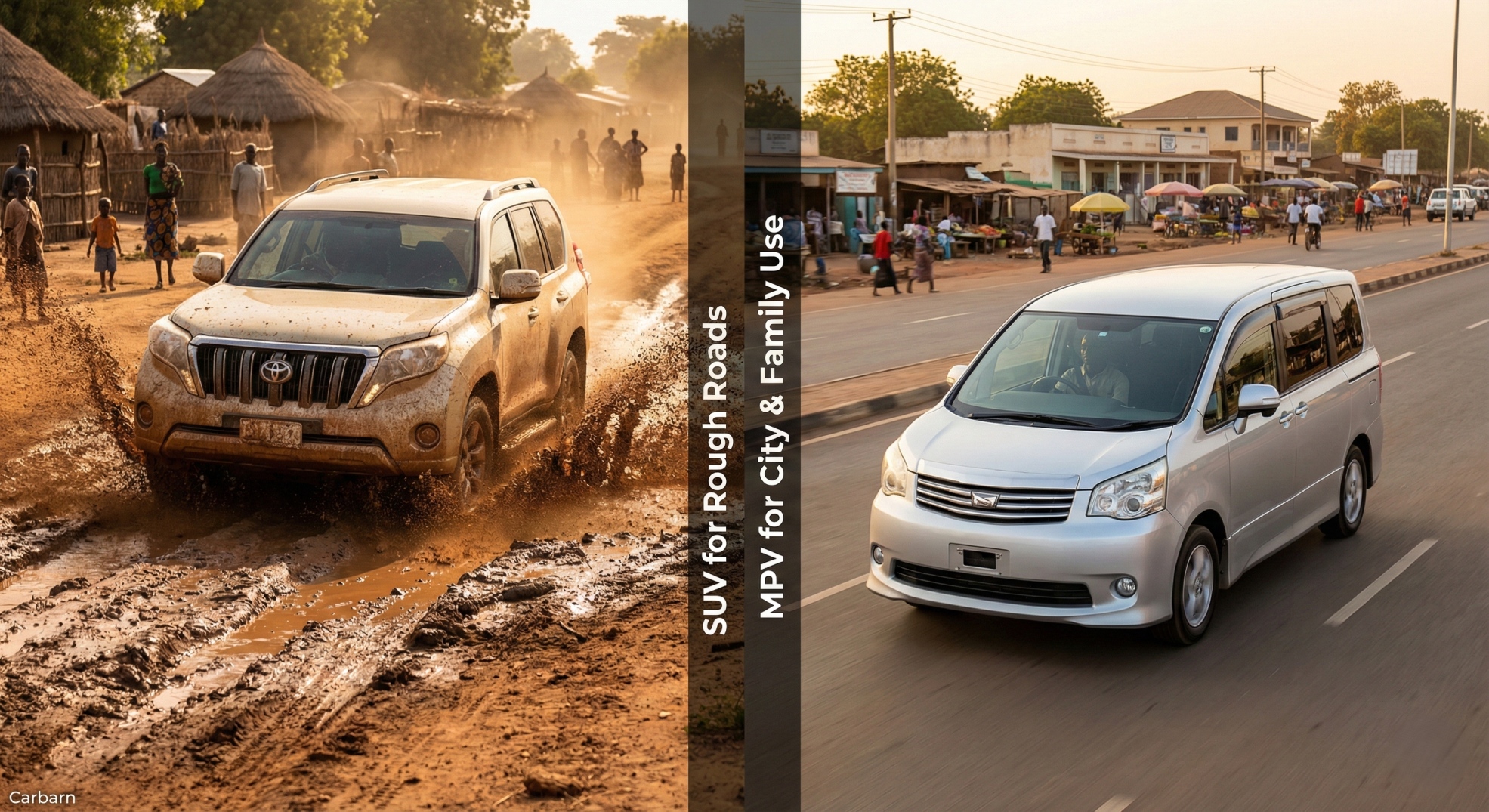
If you’re based in Juba or another town, a lot of your driving might be to school, the office, the market, and the church. You need a vehicle that is easy to park, not too thirsty on fuel, and comfortable for older family members to climb into. Here, a Japanese MPV like Toyota Noah, Nissan Serena, or Honda Stepwagon makes more sense than a heavy 8-seater SUV.
If your life is split between town and village, the picture changes. You might drive on good tarred roads during the week and face rough, muddy tracks at the weekend. Ground clearance becomes more important. You still want space and comfort inside, but you cannot ignore the underbody. In this case, a higher-riding MPV or a carefully chosen 8 seater SUV South Sudan may be the better long-term choice.
There is also the question of work. Many people in South Sudan use their family car for business. You may carry goods, staff, or clients. An 8-seater Japanese family car with folding seats allows you to switch from passenger mode to cargo mode in minutes. For small business owners, that flexibility is money saved every single day.
Overview of the Main 8-Seater Japanese Options
When you search for 8 seater cars South Sudan, you will quickly notice the same names appearing again and again. They fall into two broad groups: family vans (MPVs) and large SUVs.
On the MPV side, the main players are Toyota Noah, Toyota Voxy, Toyota Alphard, Toyota Vellfire, Nissan Serena, Suzuki Landy, Honda Stepwagon, and Nissan Elgrand. These vehicles focus on comfort, sliding doors, flexible seating, and efficient engines.
On the SUV side, you’ll see Toyota Land Cruiser, Toyota Prado, Toyota Highlander, or Sequoia in some markets, and Nissan Patrol or Armada-type SUVs, plus models like Honda Pilot where available. These were born for tough terrain and heavy loads, with strong four-wheel-drive systems and high ground clearance.
For South Sudan, the most realistic shortlist usually includes Toyota Noah/Voxy, Nissan Serena, Honda Stepwagon, Toyota Alphard/Vellfire, and for tougher use, Land Cruiser/Prado. Starting from these models saves you from wasting time on rare or unsuitable vehicles.
Toyota Noah & Toyota Voxy – The Everyday Heroes for Big Families
Ask mechanics, dealers or experienced drivers in the region what they think about the best 8-seater Japanese family car South Sudan, and the name Toyota Noah or its sibling Toyota Voxy will come up quickly. These vans have quietly become the “default” family car in many parts of East and Central Africa.
Inside, a Toyota Noah or Toyota Voxy feels like it was designed by someone who knows exactly what a family goes through every day. The sliding doors are a blessing in tight parking spaces and crowded streets. Children can climb in easily. Older relatives do not need to lift their feet too high. The three rows of seats can be rearranged, folded or tumbled forward to create space for luggage, groceries or even small cargo for your business. With eight seats in total, you can take the whole household plus a couple of extra passengers without hiring a second vehicle.
Under the bonnet, most Toyota Noah and Toyota Voxy models use around a 2.0-litre petrol engine paired with an automatic or CVT transmission. This combination is designed more for steady, efficient driving than for racing. For South Sudan, that is a good thing. You get enough power for city driving and inter-city trips, without the fuel bills of a giant SUV. Mechanics in the region are familiar with these engines, and spare parts are relatively easy to find, which keeps maintenance predictable.
In terms of price, Noah and Voxy give you a wide range. Older models can often be found at lower prices, making them attractive if you are on a tight budget but still want space. Newer, well-maintained or hybrid Noahs cost more, but they bring better safety, technology and fuel savings. If you are comparing all options for 8 seater cars South Sudan, Noah and Voxy are the baseline. Everything else should be measured against them.
Toyota Alphard & Toyota Vellfire – Luxury Lounge on Wheels
If Toyota Noah and Toyota Voxy are the family workhorses, Toyota Alphard and Toyota Vellfire are the luxury lounges of the Japanese MPV world. They carry the same idea of space and flexibility but raise the standard of comfort, finish, and status.
Step inside a typical Alphard and it feels more like sitting in a living room than a car. The seats are soft, often leather-trimmed, and many versions offer captain chairs in the second row with armrests, footrests and generous legroom. The ride is quiet and smooth, helped by good sound insulation and suspension tuned for comfort. For long trips between cities or airport runs for VIP guests, this matters a lot. Nobody arrives tired or cramped.
The price for this luxury comes in two forms. First, the purchase cost: Alphards and Vellfires sit higher in the market than Noah, so the initial investment is larger. Second, there is fuel and maintenance. Many Alphard models use 2.4–3.5-litre petrol engines. They move the heavy body with ease, but naturally use more fuel than a smaller 2.0-litre MPV. Tyres, suspension parts and premium components can also cost more.
For some people, that trade-off is worth it. If you are a business owner, an NGO director or someone who frequently carries important guests, an Alphard or Vellfire sends a strong message while still delivering real practicality as an 8-seater Japanese family car South Sudan. But if your priority is simply the cheapest running cost, you may be happier with a Noah or Serena.
Nissan Serena, Suzuki Landy & Honda Stepwagon – Smart Alternatives to Toyota
Toyota is not the only name in the game. Nissan Serena, Suzuki Landy and Honda Stepwagon are often the clever choices for buyers who want the same functionality with a different badge – and sometimes a better price.
Inside a Serena or Stepwagon, you will find the same core features that make Japanese MPVs so popular: three rows of seats, sliding side doors, and plenty of tricks to fold, slide and split the seats. Families appreciate the walk-through cabin design that allows children to move between rows easily, while adults enjoy the upright seating position and good visibility.
Many Serena and Stepwagon models use 2.0-litre petrol engines, sometimes with mild hybrid support. In daily driving, they offer similar fuel economy to Noah, and some variants are even more efficient. Because these models can be slightly less “famous” than Toyota in some markets, you may find that a carefully chosen Serena or Stepwagon gives you a newer year, better condition or richer specification for the same money you would pay for an older Noah.
The only important point here is support. Before choosing a non-Toyota option, talk to local mechanics and parts suppliers. If they are comfortable working on Nissan or Honda MPVs and can source parts quickly, then a Japanese MPV South Sudan like Serena, Landy or Stepwagon can be one of the smartest purchases you ever make.
Large Japanese 8-Seater SUVs
There are families in South Sudan for whom an MPV is simply not enough. Maybe you live far from the city, regularly cross rough tracks or flood-prone routes, or you tow trailers and carry heavy loads. In that case, a 7–8 seater Japanese SUV begins to look very attractive.
Models like Toyota Land Cruiser, Toyota Prado, Toyota Sequoia or Highlander, Nissan Patrol, Armada-type SUVs and Honda Pilot are built with rugged frames, strong four-wheel-drive systems and high ground clearance. They are designed to survive where smaller vehicles would quickly break. If your weekend drive involves deep mud, sand or stony hills, these vehicles give you the confidence to keep going.
However, everything in life has a cost, and with big SUVs the costs are clear. Large petrol or diesel engines demand more fuel, especially when the car is loaded with eight people and luggage. Tyres are larger and more expensive. Suspension and brake components are heavier. Insurance can also be higher. For someone whose everyday life is mostly in Juba traffic, these costs may not make sense.
The right way to look at a 8 seater SUV South Sudan is to ask a simple question: “Do I really need this level of off-road ability, or do I just like the image?” If the answer is that you truly need it – because of your work, your farm, your village location or your security – then a Land Cruiser–type SUV is worth every extra litre of fuel. If not, a good MPV is usually a far better investment.
Which 8-Seater Powertrain Works Best in South Sudan?
More and more 8-seater Japanese family cars now come with hybrid options, especially newer generations of Toyota Noah and Toyota Alphard. The idea of using less fuel is always attractive, but is a hybrid practical in South Sudan?
A hybrid 8-seater shines when you drive in the city. In start–stop traffic, the electric motor can help move the car with much lower fuel use. Over time, this difference can save a lot of money, especially if fuel prices climb. Hybrids also tend to be newer models, which means better safety features, more modern infotainment systems and a more refined driving experience.
The challenge is in support and long-term planning. A hybrid system is more complex than a standard petrol engine. It includes high-voltage batteries, inverters and extra control units. If you are going to buy a hybrid Japanese 8-seater family car South Sudan, you should have a clear idea of which workshop will maintain it, where spare parts will come from, and how you will manage battery replacement later in the car’s life.
For many families, a simple rule works well. If you mostly drive in Juba and nearby towns, and you have access to a trusted workshop that understands hybrid cars, then a hybrid 8-seater can be an excellent choice. If you spend most of your time on long, rough routes, far away from specialist technicians, a straightforward petrol 8-seater like a standard Noah or Serena may be the safer option.
Looking Beyond Price: Total Cost of Ownership
When you’re choosing the best 8-seater Japanese family car South Sudan, it’s tempting to focus on the purchase price alone. But the smarter way is to think in terms of “total cost of ownership.”
Imagine two vehicles. One is cheap to buy but uses a lot of fuel, needs constant repairs and has rare, expensive parts. The other is slightly more expensive at the start, but uses less fuel and has parts available everywhere. Over three to five years, the second car almost always works out cheaper – and far less stressful.
For an 8-seater, fuel is often the largest ongoing cost. A mid-sized MPV with a 2.0–2.5-litre engine will usually use much less fuel than a big SUV with a 4.0-litre engine, especially in town. Tyres and brakes are also cheaper on lighter vehicles. Routine servicing is easier, and you are less likely to end up parked at the side of the road waiting for a specialist part to be imported.
Ownership costs go beyond the technical side. If your car is reliable, you spend less time cancelling trips, rescheduling meetings and worrying about breakdowns. In a place where transport can already be a challenge, that peace of mind has real value.
A Simple Process to Choose Your 8-Seater
Rather than trying to hold a hundred thoughts in your head, follow a clear, step-by-step process.
First, define your roads. Write down honestly where you drive. If most of your kilometres are in Juba and its surroundings, you are a city driver. If you split time between city and village, you are mixed. If you are off-road more often than on tar, you are a rural driver. This single decision already points you towards MPV or SUV.
Second, fix your total budget. Don’t just think about the car’s price. Include estimated shipping, duty, registration, first service and a small reserve for immediate repairs. Decide what you can afford comfortably, not what stretches you until you can’t breathe.
Third, choose your body type. City drivers with big families usually do best with MPVs like Toyota Noah, Nissan Serena or Honda Stepwagon. Mixed drivers can choose between a higher-riding MPV and a moderate SUV. Rural drivers who face serious mud and bad roads repeatedly are the ones who should look at Land Cruiser or Prado–type SUVs.
Fourth, make a shortlist of two or three specific models and compare them. Look at engine size, fuel economy, seating comfort, cargo space, safety features and parts availability. Talk to mechanics. Ask which models they like, which ones they see with fewer serious problems, and which ones are easier to fix.
Finally, use a trusted platform such as Carbarn South Sudan to look at actual vehicles that match your chosen model. Reading about “Noah” is useful, but seeing a specific Noah with known mileage, inspection notes and photos is how decisions really happen.
Matching the Right 8-Seater to Your Life
To make this more concrete, imagine three different buyers.
The first lives in Juba, has four children and helps with extended family errands. Most driving is within the city and on main roads. For this family, a Toyota Noah or Voxy is almost perfect. It has space for everyone, is easy on fuel, and mechanics know it well. A Nissan Serena or Honda Stepwagon would also be a strong candidate.
The second buyer is a business owner who travels frequently between cities and often carries colleagues or visiting partners. Comfort and image matter just as much as space. Here, a Toyota Alphard or Vellfire becomes very attractive. The interior feels premium, long trips are relaxing, and passengers feel looked after. A high-spec Noah can also work for this purpose.
The third buyer lives outside town and regularly drives through muddy tracks and poorly maintained roads. For this family, the top priority is toughness and ground clearance. A Land Cruiser or Prado in a 7–8-seater configuration may be the only realistic option. Fuel costs will be higher, but breakdowns in the middle of nowhere would cost far more in stress and risk.
Each of these people is searching for the “best 8-seater Japanese family car South Sudan,” but the right answer is different because their lives are different. Seeing which scenario is closest to yours will help you choose confidently.
Common Mistakes South Sudan Buyers Make
Many painful stories start the same way: “It looked cheap.” Buyers are often drawn to 8-seater vehicles with very low upfront prices, but they don’t ask why. Maybe the car has serious accident history, maybe the engine is tired, or maybe parts are difficult to find. A few months later, they are paying for repairs so often that the “bargain” becomes more expensive than a clean, slightly higher-priced car would have been.
Another mistake is choosing an engine that is simply too large for the job. A huge 4.0-litre SUV engine can be fun for a while, but when you fill the tank and see how quickly the fuel needle falls, the fun disappears. If you mostly drive in town, that money is better used on school fees, business expansion or savings.
A third common error is ignoring service and parts support. A rare model with unfamiliar technology might impress your neighbours, but if no mechanic nearby knows how to work on it, you are stuck. Waiting weeks for a small part turns simple issues into long, stressful dramas.
You can avoid all of this by focusing on total cost, checking service support, and using serious inspection information instead of just shiny photos.
How Carbarn South Sudan Fits Into the Picture
A guide like this gives you the theory. To turn theory into reality, you need real vehicles to compare, clear information on condition, and support with shipping and paperwork. That is where Carbarn South Sudan comes in.
Carbarn specialises in Japanese used cars for markets like South Sudan, which means it understands the conditions, the roads and the buyer expectations. On a Carbarn platform, you can search specifically for 8 seater cars South Sudan, filter by make, model, year, engine size, fuel type and price, and then open each vehicle to see detailed photos and inspection points.
Instead of wondering whether a particular Noah or Alphard is clean, you can read actual inspection comments. Instead of guessing how the car will reach you, you get transparent information about shipping routes, timings and required documents. This kind of structure is what turns a risky import into a controlled, manageable process.
By combining the knowledge in this article with the tools and listings available through Carbarn, you move from being a confused shopper to a confident buyer with a clear plan.
Your Best 8-Seater Japanese Family Car for South Sudan
The phrase “best 8-seater Japanese family car South Sudan” does not have a single answer, but it does have a clear method. Start with your roads, your family size and your budget. Decide honestly between MPV and SUV based on how you actually live. Look hard at total cost, not just the price tag. Prioritise models that are already tried and tested in similar conditions: Toyota Noah and Voxy, Nissan Serena, Honda Stepwagon, Toyota Alphard and Vellfire, and Land Cruiser or Prado–type SUVs.
If city and highway driving with a big family is your reality, a Japanese MPV is usually your best friend. If your life is divided between office and off-road, a tougher SUV may be worth the extra cost. Either way, using a structured process and a reliable partner like Carbarn South Sudan means you can decide with confidence instead of fear.
Your next step is simple: choose your category (MPV or SUV), set a realistic total budget, shortlist two or three models, and start comparing real vehicles with clear inspection information. The right 8-seater Japanese family car can serve your household, your work, and your community for many years. With careful thinking and the right support, you can find it and make it yours.