Fuel economy matters, but cheaper energy is not useful if you cannot depend on it. An electric car may reduce petrol purchases, yet charging becomes difficult when power is unavailable overnight.
For most South Sudanese buyers, hybrid vs electric cars in South Sudan comes down to more than fuel savings. You need to consider Juba traffic, electricity reliability, journeys to Nimule or Yei, rough roads, servicing and parts. This guide also explains which fuel-efficient cars for South Sudan suit city driving and which make more sense for longer routes.
This guide compares conventional hybrids, plug-in hybrids and full electric cars. It gives a practical 2026 verdict without assuming that public charging infrastructure is already established.
Quick Answer
- For buyers who cannot guarantee overnight charging or regularly travel beyond Juba, a conventional hybrid is the lower-risk option.
- A full EV may suit a Juba-based driver with dependable home or workplace charging, predictable routes and backup power.
- The World Bank’s current WDI API reports 8.4% electricity access for 2022 (World Bank, updated 2026).
- Your route, backup power and model-specific parts support matter as much as fuel economy.
For the latest eligibility details, read the South Sudan import rules and costs before comparing vehicles.
Hybrid, Plug-In Hybrid and EV Differences
In 2026, Toyota Japan lists up to 32.6 km/L WLTC for a specified Prius X 2WD grade (Toyota Prius X Grade specifications, 2026). A conventional hybrid uses petrol and recovered electric energy, while a full EV depends entirely on stored electricity.
A conventional hybrid, or HEV, combines a petrol engine with an electric motor. It recovers some energy during braking, a process called regenerative braking. The battery charges while driving, so you do not need to plug the car into a wall.
That arrangement matters during power cuts. Where petrol is accessible, you can continue driving by refuelling, even when overnight charging would be impossible. Confirm fuel access for the routes you use.
A plug-in hybrid, or PHEV, has a larger battery and can be charged externally. It still carries a petrol engine for longer journeys or when the battery is low. If you rarely charge it, much of its potential efficiency benefit disappears.
A full electric vehicle, also called a BEV, has no petrol engine. The battery powers the electric motor, and the vehicle must connect to suitable charging equipment. The U.S. Department of Energy explains these differences in its Alternative Fuels Data Center hybrid and electric vehicle guides, 2026.
Why Does Electricity Reliability Change the EV Decision?
In 2026, the World Bank’s current World Development Indicators series reports electricity access of 8.4% in South Sudan for 2022, after reporting 7.7% for 2021 (World Bank electricity-access indicator, 2026). That makes dependable charging the first EV ownership question.
The figures need careful reading. A 2025 World Bank publication, Tracking SDG 7: The Energy Progress Report 2025, is another source for South Sudan’s electricity-access data (World Bank Tracking SDG 7 report, 2025). Because the sources publish different values for 2022, do not combine them as a simple year-on-year trend. Quote the dataset name and update date with any figure.
| World Bank data snapshot |
Electricity access |
| 2021, current WDI series |
7.7% |
| 2022, current WDI series |
8.4% |
These figures should not be treated as a perfect comparison. The access indicator measures whether people have electricity access; it does not establish that power is available every night or that the supply can support vehicle charging. That distinction is an inference relevant to car ownership, not a direct finding from the percentage.
The World Bank’s B-READY 2025 South Sudan assessment gave electricity reliability a score of 5.08 out of 11.11, marked as partial performance (World Bank B-READY South Sudan 2025, 2025). This is a business-environment indicator, not a household outage survey, but it reinforces the need for a backup plan.
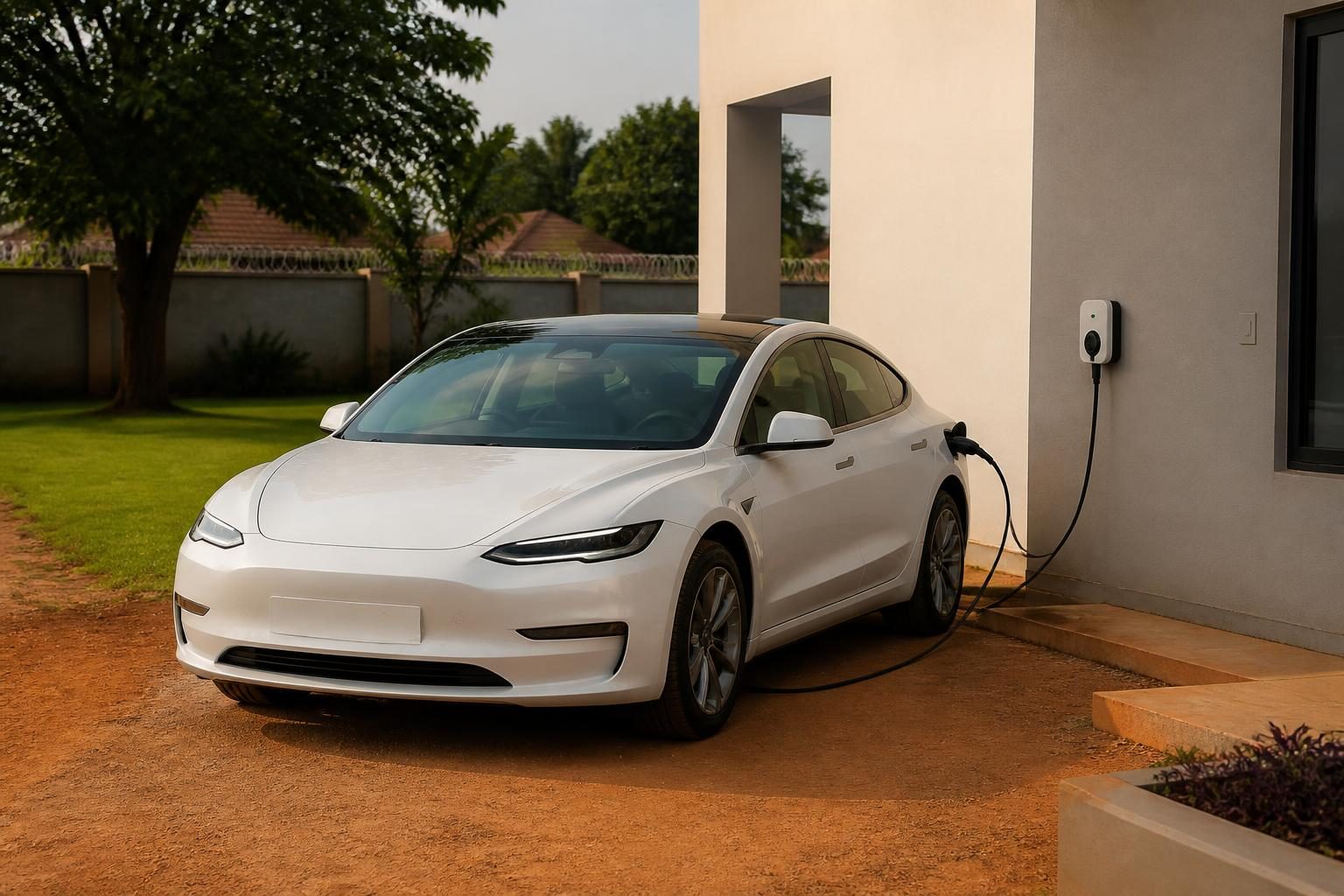
An electric sedan charges beside a modern home in a walled compound.
Before choosing an EV, ask whether you can charge overnight at home or work. Also check whether solar power, battery storage or a generator can keep the car usable during outages. No authoritative public charging map was identified during our research. Confirm any local charger directly before relying on it.
Which Powertrain Works Best for Juba, Nimule and Longer Road Journeys?
In 2026, Toyota Japan rates a specified Prius X 2WD at up to 32.6 km/L under the WLTC test cycle (Toyota Prius X Grade specifications, 2026). A hybrid can offer broader route flexibility where petrol is more accessible than reliable charging, but confirm fuel access on the routes you use.
| Factor |
Conventional hybrid |
Full electric car |
| Energy source |
Petrol and recovered electric energy |
Stored electricity |
| External charging |
Not required |
Required |
| Juba stop-start traffic |
Strong fit |
Strong fit with dependable charging |
| Power-cut resilience |
Can continue using petrol |
Depends on battery charge or backup power |
| Longer journeys |
More flexible |
Needs route and charging planning |
| Rough-road suitability |
Depends on clearance and condition |
Depends on clearance, condition and battery protection |
| Routine maintenance |
Petrol engine and hybrid systems |
Fewer routine mechanical items |
| Specialist support |
Model-dependent |
Model-dependent and potentially narrower |
Juba traffic can suit a conventional hybrid because braking and low-speed driving allow the electric motor to assist more often. A full EV can also work well on predictable urban routes, provided charging is available where the car is parked.
Longer journeys change the risk. If you regularly travel towards Nimule, Yei or other destinations, petrol backup reduces the need to plan every stop around electricity. What happens if your destination has no suitable charger, or the return journey takes longer than expected?
As practical buying guidance, road suitability depends on the vehicle, not only its powertrain. Ground clearance, tyre condition, suspension health and underbody protection deserve checks on unpaved routes. A low-clearance city EV may be a poor fit for regular rough-road travel, depending on its condition and protection.
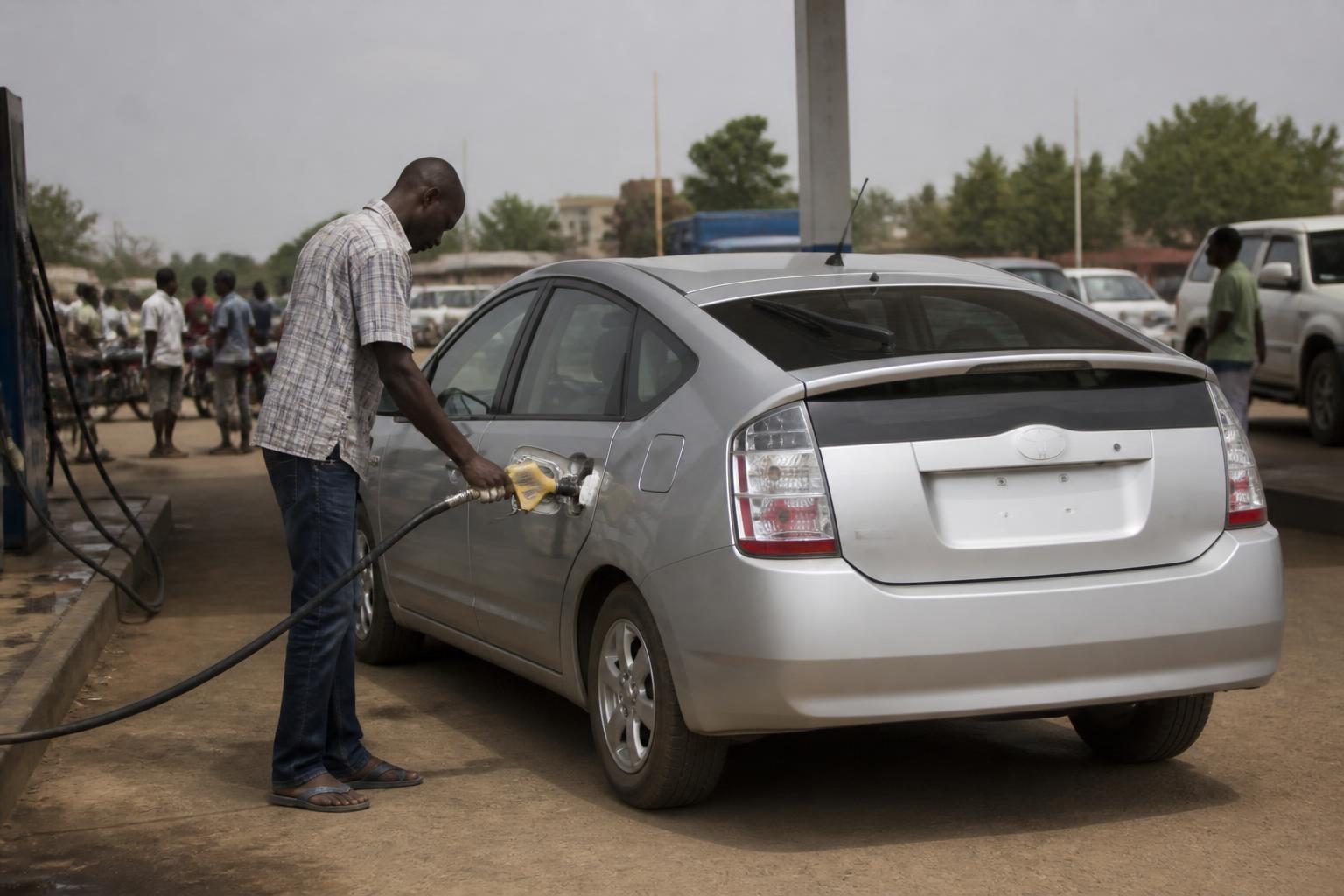
A driver refuels a silver hybrid car amid traffic at a busy petrol station.
Can an Electric Car Really Cost Less to Own?
In 2025, Toyota Japan listed up to 32.0 km/L WLTC for a specified Aqua configuration (Toyota Aqua specification sheet, 2025). An EV may cost less to run each day, but only when charging is dependable and affordable.
A fair ownership comparison includes more than petrol or electricity. Consider each cost category before deciding:
| Ownership category |
What to check |
| Vehicle purchase |
Age, condition, specification and battery information |
| Shipping and import |
Shipping route and inland transport |
| Customs and applicable taxes |
Dutiable value and destination-town requirements |
| Clearance |
Clearing agent and possible arrival inspection |
| Registration |
Registration and licensing costs |
| Energy |
Petrol, grid electricity, solar or generator use |
| Repairs |
Suspension, tyres, battery and electrical systems |
| Charging |
Equipment, installation and backup power |
South Sudan import guidance states that VAT is 20% of the dutiable value. Customs duty varies according to the vehicle specification and destination, including differences between Juba, Yei and Nimule. Never treat a vehicle-and-shipping price as the final on-road total.
The practical comparison is not simply petrol versus electricity. It is fuel access versus dependable energy access. An EV charged by a diesel generator may reduce petrol purchases, but it still depends on fuel, equipment and reliable charging arrangements.
WLTC figures are laboratory test results. Heat, air-conditioning use, traffic, road surfaces, tyre pressure, vehicle age and loading can all change real-world consumption.
Servicing and Buyer Fit by Powertrain
In 2025, global electric-car sales exceeded 20 million, according to the IEA’s Global EV Outlook 2026 (IEA Global EV Outlook 2026, 2026). Global growth does not remove the need to check local parts, diagnostics and repair support.
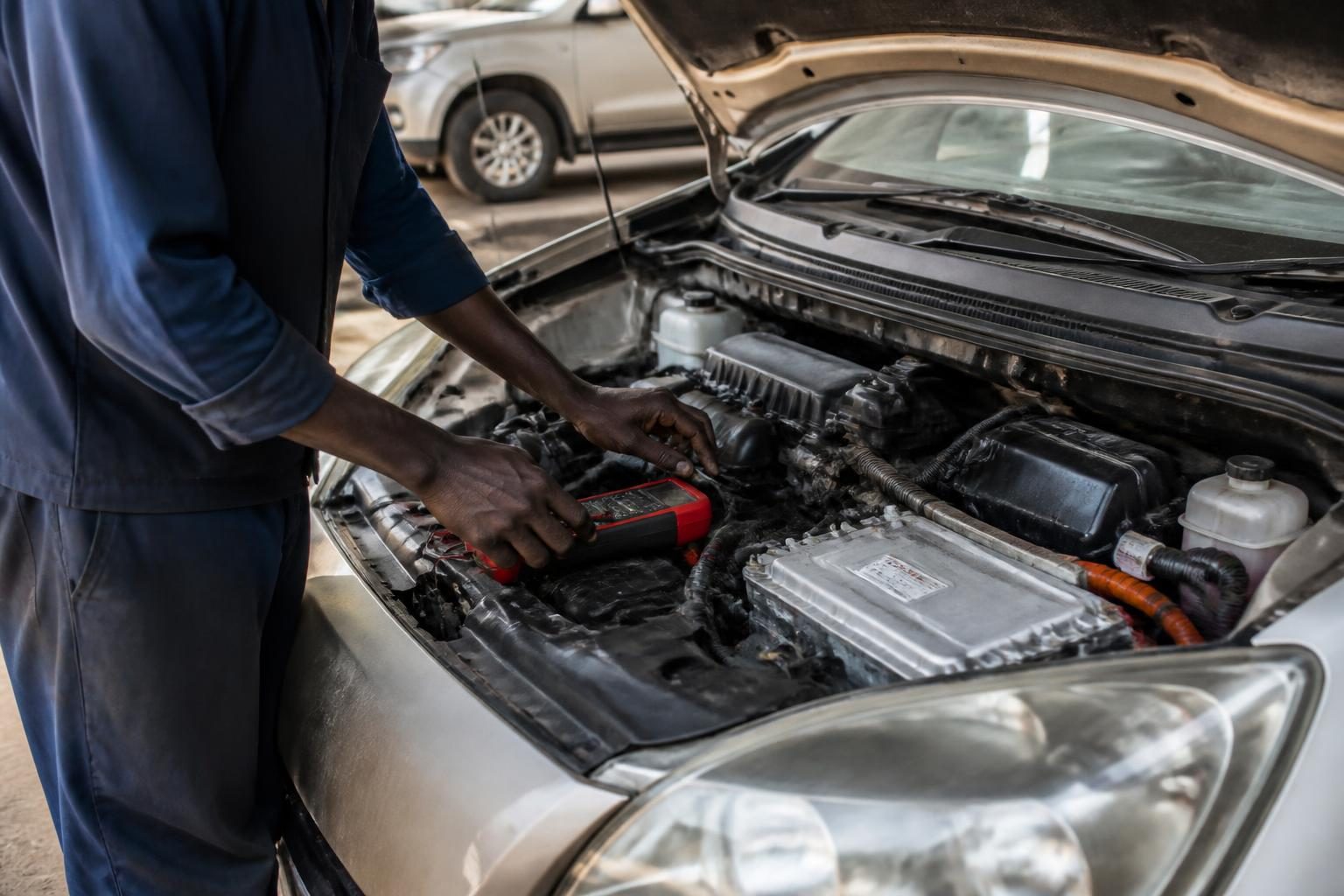
A mechanic inspects a hybrid car's engine bay with a diagnostic tool.
A Japanese hybrid may be easier to support than an unfamiliar EV in some locations, but this depends on the model, mechanic capability, diagnostic tools and parts supply. Before payment, check the auction sheet, auction grade, inspection report, accident history, water damage, warning lights, odometer and underbody condition.
Ask whether a mechanic can diagnose the specific hybrid or EV system. Also check whether replacement parts, battery testing and electrical repair support are realistically available. Do not assume every hybrid battery will last for a particular number of years.
The buyer matrix below is editorial guidance, not measured survey data. It weighs charging access, travel distance, roads, power cuts and service support because those factors usually matter more than a global EV sales figure.
| Buyer situation |
More suitable choice |
| Juba driver with reliable home charging and predictable routes |
EV may make sense |
| Juba driver with uncertain power supply |
Conventional hybrid |
| Regular travel beyond Juba |
Conventional hybrid |
| No dependable overnight charging |
Conventional hybrid |
| Controlled compound with solar or generator backup |
Compare both carefully |
| Frequent rough-road travel in a low-clearance car |
Neither without checking suitability |
A plug-in hybrid also needs honest consideration. If you cannot charge it regularly, its larger battery may add weight without delivering its full electric-driving benefit. Based on the charging and route assumptions above, a conventional hybrid is the simpler transition for a first-time electrified-car buyer.
How Can You Choose and Import the Right Electrified Car from Japan?
Carbarn’s import-rules page lists an estimated 24–36 days to Mombasa (Carbarn South Sudan import rules, 2026). Inland transport, border clearance and final delivery to South Sudan take additional time and are not guaranteed. Its import-to-order process is therefore different from buying from a local showroom.
Carbarn South Sudan states that buyers receive an official Japanese auction sheet and an in-house inspection report before payment. Carbarn’s current South Sudan process refers to EAA pre-shipment certification. Confirm the inspection requirement and what is included in the quote before payment. Carbarn says EAA may conduct a roadworthiness inspection during customs clearance, depending on the region.
The listed price covers the vehicle and shipping. Applicable customs duty, sales tax or VAT, customs clearance, registration and licensing charges remain separate costs and must be confirmed for the vehicle, route and destination before payment. You can browse Japanese vehicles for South Sudan, compare vehicle specifications, or review Toyota Prius specifications before checking the South Sudan import rules and costs.
The practical 2026 verdict: hybrid vs electric cars in South Sudan
For buyers who cannot guarantee overnight charging or regularly travel beyond Juba, a conventional hybrid is probably the lower-risk choice. It can reduce petrol use in stop-start traffic without depending on external charging.
A full EV is a narrower choice. It may work for a Juba-based driver with dependable charging, predictable routes, backup power and confirmed technical support. Before importing, compare the vehicle’s condition, clearance, battery evidence, route and total landed cost through the how importing a Japanese vehicle works guide.