You may find a used Japanese car at an attractive price, then wonder what happens after payment. How does it reach South Sudan? Who clears it? What does duty apply to? When can you expect to use it?
South Sudan is landlocked, so a Japanese vehicle normally travels by sea to Mombasa, Kenya, then continues by road into South Sudan. This guide covers the Japan-to-Mombasa shipment and the steps after arrival; final delivery, customs clearance and costs depend on the destination town and current assessment. In 2025, the Kenya Ports Authority’s Bandari newsletter reported that South Sudan accounted for 12.7% of Mombasa’s transit cargo in 2024 (Kenya Ports Authority, “Bandari” newsletter, 2025). That figure covers general cargo, not vehicles specifically, but it shows the importance of the corridor.
This guide explains the route, eligibility rules, documents, taxes, clearing process and realistic timeline. Before paying, review the South Sudan import rules, confirm government requirements with SSRA, and obtain a written quote for your destination. The linked page is service guidance, not independent government confirmation.
Quick Answer
- A used Japanese car normally travels by RoRo from Japan to Mombasa, then by road into South Sudan.
- The August 2026 South Sudan Import Process guidance estimates 24 to 36 days to Mombasa, not to Juba or another final destination.
- Duty, VAT, clearing, registration and licensing are separate costs.
- Customs duty, excise duty and sales tax are separate from clearing, transport and registration; obtain a current assessment for the vehicle and destination.
The Route From Japan to South Sudan
A used Japanese car reaches South Sudan in several separate stages: preparation in Japan, RoRo shipping to Mombasa, inland road transport and local clearance. In 2025, the Kenya Ports Authority’s Bandari newsletter reported that Mombasa handled 13.4 million tonnes of transit cargo during 2024 (Kenya Ports Authority, “Bandari” newsletter, 2025). The figure covers all transit cargo, not vehicles alone, but it shows why Mombasa is an important regional gateway. A vehicle import follows the same broad corridor, although its documents, release process and final costs depend on the car and destination.
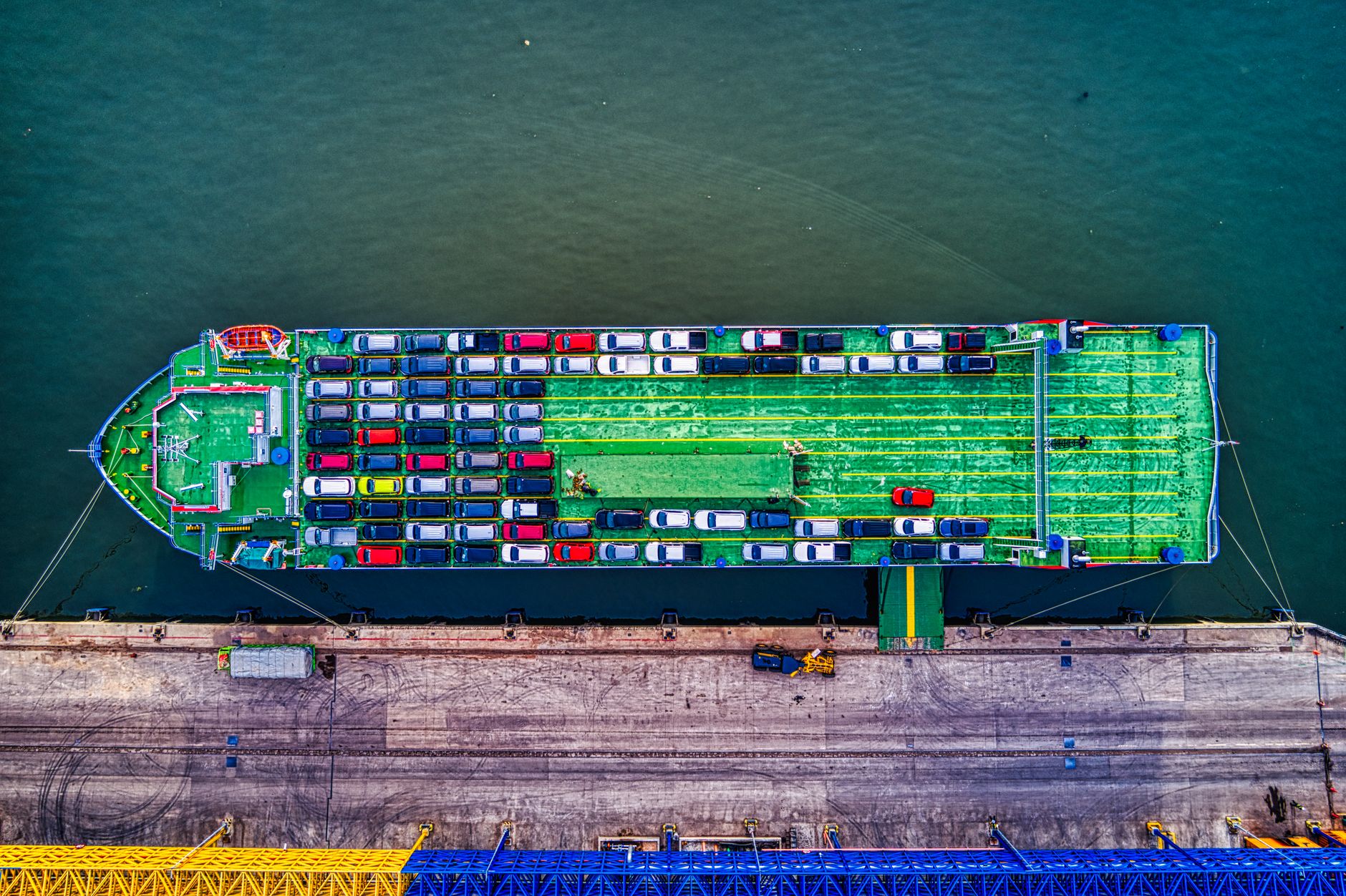 Vehicle carrier ship loaded with cars alongside a port dock.
What Happens Before the Vehicle Leaves Japan?
The buyer selects and orders the vehicle first. The exporter then prepares the invoice, export paperwork and inspection documents before booking the next available vessel.
RoRo means “roll-on, roll-off”. The vehicle is driven onto the vessel and secured for the sea journey. It is not packed inside a standard shipping container.
The vehicle arrives at the Port of Mombasa in Kenya. The port identifies multipurpose berths serving RoRo ships and describes Mombasa as part of a multimodal regional transport network (Kenya Ports Authority, “Port of Mombasa”, 2026).
Arrival at Mombasa is not the same as delivery to South Sudan. The car still needs cargo release, inland transport, customs handling and registration. Why does that distinction matter? Because the sea-shipping estimate ends at Mombasa, not at Juba, Yei or Nimule.
| Stage |
What happens |
Main responsibility |
| Japan |
Order, documents and inspection |
Exporter and buyer |
| Sea leg |
RoRo shipping to Mombasa |
Shipping provider |
| Mombasa |
Port arrival and cargo release |
Shipping provider and agent |
| Inland leg |
Road transport towards South Sudan |
Transporter and buyer |
| Final stage |
Customs, clearance and registration |
Buyer and relevant authorities |
Read the vehicle buying process before committing to an order.
Can Any Used Car Be Imported to South Sudan?
South Sudan imports covered by this guidance are right-hand drive only, and there is no age limit stated in the commercial import guidance (South Sudan import-rules guidance, 2026). Confirm the current requirements with the relevant authority before ordering. No age limit does not remove the need to check condition, parts supply, road suitability and likely resale.
If the no-age-limit guidance applies to your transaction, it gives buyers more choice, but it also makes condition more important. Check the auction grade, inspection report, service history, parts availability, ground clearance, fuel type and engine size as well.
A small hatchback, a larger SUV and a people-mover can each create different transport and customs questions. Vehicle specification may affect the customs assessment, while the final destination can affect inland transport and clearing costs.
Older cars may cost less to buy, but lower purchase cost does not always mean lower landed cost. A vehicle that is difficult to service or lacks available parts can become expensive after arrival.
Use the South Sudan import rules and regulations for service details, confirm legal requirements with SSRA, and consult the Japanese vehicle specification reference when checking a vehicle.
[UNIQUE INSIGHT] “No age limit” should be treated as permission to assess more vehicles, not as a reason to ignore condition. The sensible question is not whether an older car can enter. It is whether its condition, parts supply and road suitability justify the complete landed cost.
How Are Duty, VAT and Landed Costs Calculated?
The vehicle listing price is not the landed cost. Landed cost is the complete amount needed to clear, transport and register the vehicle in South Sudan. The FY2023/24 Financial Act set sales tax on imported goods at 20% of the combined customs value, excise duty and customs duty (National Revenue Authority, “Financial Act FY 2023/24”, 2023). That is historical legislation, not proof of the current 2026 assessment. Confirm the current tax basis with the South Sudan Revenue Authority (SSRA) before paying.
Three terms help explain the calculation:
- CIF value: Cost, insurance and freight to the relevant port or customs point.
- Dutiable value: The value customs uses to calculate applicable charges.
- Landed cost: The complete amount needed to clear, transport and register the vehicle.
South Sudan’s dated Financial Act FY 2023/24 uses customs-value and CIF concepts, but it should not be treated as the current tariff schedule. Ask SSRA or a qualified clearing agent for a current assessment instead.
| Cost line |
What it covers |
Planning treatment |
| Vehicle |
Purchase price |
Confirm on the invoice |
| Shipping |
Sea transport to Mombasa |
Confirm what is included |
| Inspection |
Pre-shipment inspection |
Confirm whether included |
| Duty and VAT |
Customs and tax charges |
Obtain a current assessment |
| Clearing |
Agent’s customs service |
Request a written fee |
| Port and storage |
Handling after arrival |
Confirm with the agent |
| Inland transport |
Mombasa to the final town |
Destination-specific |
| Registration and licensing |
Legal use in South Sudan |
Separate buyer cost |
Do not rely on a single online customs-duty figure or an old tariff for every vehicle. Customs duty and excise duty can vary with the vehicle specification and destination town, so confirm the current assessment with SSRA. Juba, Yei and Nimule can also involve different transport and clearing costs.
Check what the vehicle price includes and excludes before comparing offers.
What Happens After the Car Reaches Mombasa?
After a car reaches Mombasa, it needs cargo release, inland road transport and South Sudan customs handling before registration. As accessed in August 2026, the South Sudan Revenue Authority Customs eServices portal listed services including customs-agent licensing, customs declarations and vehicle-registration queries (South Sudan Revenue Authority, “Customs eServices”, 2026). The portal should be checked for current service descriptions rather than treated as a complete guide to tariff calculation, payment, inspection and clearance. The exact sequence depends on the vehicle, transit status and destination town.
 A clerk reviews paperwork spread across an office desk.
A clearing agent helps manage customs formalities on the importer’s behalf. They may review the bill of lading, prepare the declaration, explain the assessed value, arrange inspections and coordinate cargo release.
The South Sudan Trade Information Hub lists “Import of vehicles by road” as an official procedure, including importer or exporter registration and import licensing steps (South Sudan Trade Information Hub, “Import of vehicles by road”, 2026).
Ask a clearing agent these questions before paying:
- Does your quote cover Mombasa only or the final destination?
- Which amounts are official taxes?
- Which amounts are your service fees?
- Are port storage and inland transport included?
- Who submits the customs declaration?
- Will I receive receipts for duty, VAT and other payments?
- Which documents must be originals?
- Could inland transport or clearing costs differ for Juba, Yei and Nimule?
The exact payment and release arrangement can depend on the customs declaration, transit status and current instructions. Carbarn’s guidance says an EAA roadworthiness inspection may occur during customs clearance, depending on the region. Confirm that operational requirement with the relevant authority or clearing agent.
Documents Needed for Clearing
The core clearing documents identify the vehicle, its value, its shipment and its importer. In August 2026, the SSRA Customs eServices portal listed customs declaration and vehicle-registration query services (South Sudan Revenue Authority, “Customs eServices”, 2026). Check the current portal wording for additional assessment services, then ask your clearing agent which originals SSRA requires for the specific vehicle and destination.
Keep the likely core documents ready:
- Japanese export certificate.
- Registration certificate from the country of origin, where applicable.
- Commercial or proforma invoice.
- Invoice showing the CIF value, where applicable.
- Bill of lading.
- Buyer identification and destination-specific documents.
- Customs declaration and clearing-agent paperwork.
- Proof of payment for taxes and official charges.
Carbarn may also supply an official Japanese auction sheet, its condition report and an EAA pre-shipment inspection certificate. Treat these as exporter or service documents, not as a universal government checklist.
EAA identifies South Sudan among the markets covered by its pre-shipment inspection services (EAA, “Services”, 2026). For a Carbarn transaction, confirm that the EAA inspection certificate is included before the vehicle leaves Japan.
Check the chassis number across the auction sheet, invoice, export certificate, inspection report and bill of lading. One mismatch can lead to questions or corrections at the clearance stage.
For more detail, review the documents provided during the vehicle buying process and common questions about importing a vehicle.
How Long Does Importing a Car Take?
The August 2026 South Sudan Import Process guidance estimates 24 to 36 days from Japan to Mombasa (South Sudan Import Process guidance, 2026). That is a sea-leg estimate, not a final delivery promise. The car still needs Mombasa cargo handling, inland road transport, customs clearance and registration before it can be used in Juba or another South Sudanese town. Weekly departures may provide regular shipping opportunities, but vessel schedules and later stages can change the timing.
A typical sequence looks like this:
- Vehicle selection and order confirmation.
- Payment and export-document preparation.
- Inspection and export processing.
- Booking on the next available weekly sailing.
- Japan-to-Mombasa sea journey, estimated at 24 to 36 days.
- Mombasa port handling and cargo release.
- Inland road transport.
- Customs, possible inspection and registration.
Vessel schedules, port handling, document corrections, customs review and road conditions can all cause delays. A clear process example is: vehicle selected, invoice issued, payment confirmed, inspections completed, RoRo sailing booked, Mombasa arrival tracked, then road transport and local clearance arranged.
Each step has its own timing. That is why the Japan-to-Mombasa estimate should never be presented as final delivery to South Sudan.
How Does Carbarn Support Your Import?
Two reports are supplied before payment under Carbarn’s August 2026 South Sudan process: an official Japanese auction sheet and a Carbarn inspector report (Carbarn, “South Sudan Import Process”, 2026). The same process requires a mandatory EAA pre-shipment inspection for South Sudan, which is included in the stated price. Confirm the provider and certificate on the proforma invoice.
Carbarn’s listed price covers the vehicle, shipping and the included EAA pre-shipment inspection. It does not cover duty, tax, customs clearance, arrival inspection, registration or licensing.
Payment is arranged through an official proforma invoice by bank transfer to Japan or card. The online dashboard provides invoices, the bill of lading, inspection documents and live vessel tracking.
The service supports the Japan-side purchase, inspection and shipping stages. The buyer remains responsible for South Sudan customs, clearing, inland transport arrangements and local registration.
You can review the vehicle buying process, read the South Sudan import rules or browse available Japanese vehicles. Confirm government requirements with SSRA before payment.
Before you pay, importing through Mombasa may suit you if you can budget beyond the vehicle price, understand the separate road leg and have confirmed the destination town. Pause if you need one fixed total before customs assessment or cannot verify the document chain.
The main lesson is simple. The Japan purchase, Mombasa sea leg, inland transport, customs clearance and registration are separate stages.
Ask for a written quote that separates duty, VAT, clearing fees, port charges, transport, registration and licensing. Confirm current rules with the relevant authority and a qualified clearing agent before payment.