The Kenya Revenue Authority (KRA) has approved 15 vendors to supply e-seals, the tracked electronic locks fitted to cargo under customs control, according to KRA notice 2393, checked on 21 November 2026. Under notice 2401, KRA's own seals on dry cargo and motor vehicle units stopped operating on 26 October 2026. This guide explains what changed, who handles it, and what stays the same for a car heading to South Sudan.
Quick Answer
- KRA approved 15 e-seal vendors in notice 2393 and ended its own seals on dry cargo and motor vehicle units from 26 October 2026 in notice 2401.
- From that date, tracking uses devices from approved vendors only, and the user picks the vendor.
- Your clearing agent (who handles customs paperwork) or transit agent (who moves the car through Kenya) usually arranges the seal, but confirm this with them.
- Neither notice sets a fee or says who pays. Ask your agent.
What did KRA change, and when?
KRA stopped supplying its own electronic seals and handed the job to approved private vendors.
Notice 2401 states that KRA-owned e-seals for tagging dry cargo and motor vehicle units cease to operate effective 26 October 2026. From then on, monitoring is done exclusively through devices supplied by the approved vendors. Both notices describe the arrangement as a private commercial agreement between vendor and user, and both say users are at liberty to select any approved vendor.
|
Before 26 October 2026 |
From 26 October 2026 |
Source |
| Who supplies the seal |
KRA-owned e-seals under RECTS |
Devices from approved vendors, 15 approved |
Notices 2393 and 2401 |
| Who chooses the vendor |
Not stated in the notices |
The user picks any approved vendor |
Notice 2401 |
| Basis of the arrangement |
Not stated in the notices |
Private commercial agreement, no fee stated |
Notices 2393 and 2401 |
What does an e-seal do?
An e-seal is a tracked lock on a cargo unit. It lets customs follow that unit while it moves across Kenya, rather than relying on paper checks alone. KRA notice 2340, dated 30 January 2026, describes RECTS as a web-based system in which "export and transit cargo moving through Kenya is fitted with electronic seals and monitored centrally".
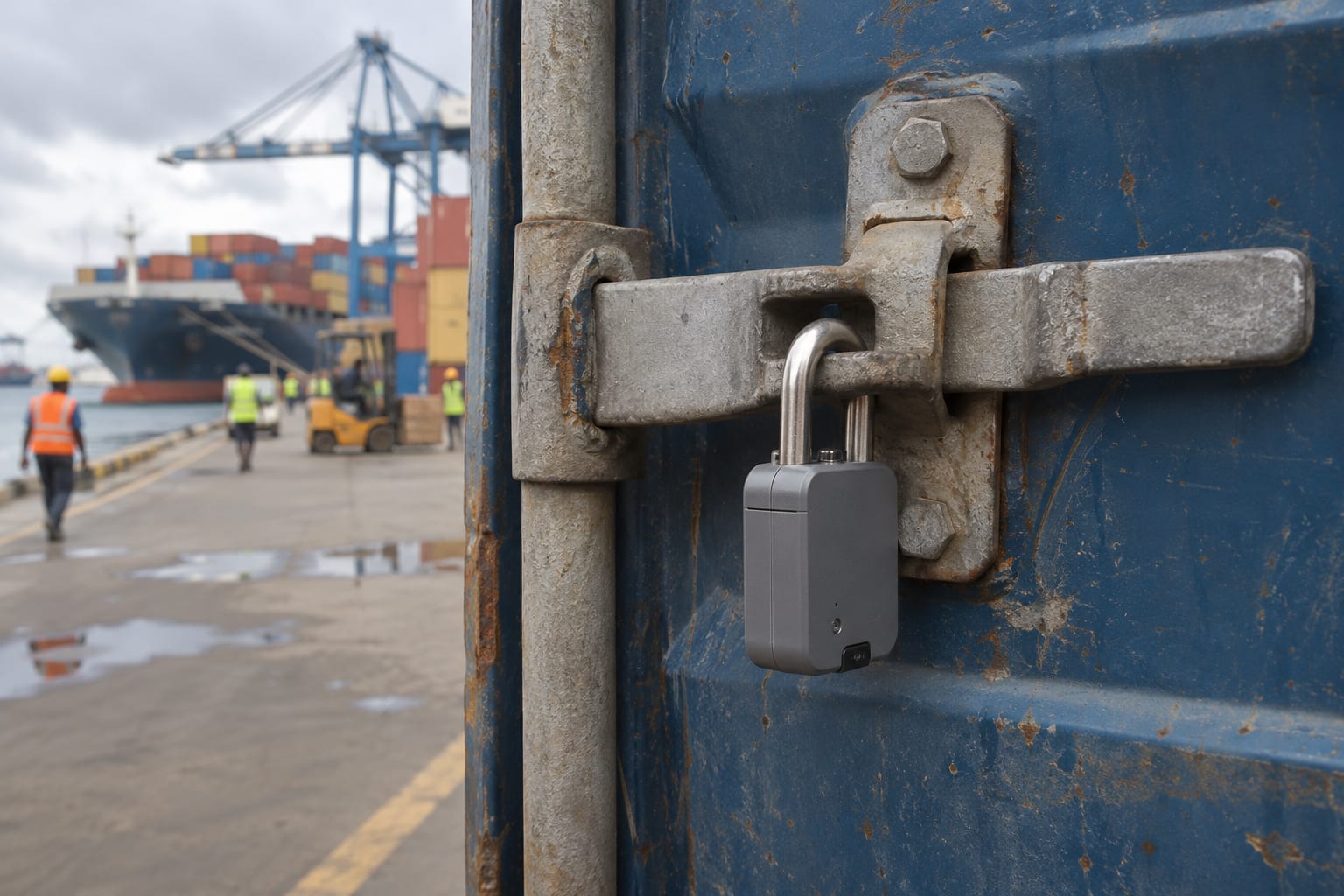 Illustration: An electronic padlock attached to a shipping-container door latch at a port.
What does it mean for a car heading to South Sudan?
Your car travels from Japan to Mombasa by ship, then by road into South Sudan. If a seal is needed, that step would most likely happen in Kenya, after the ship arrives and before the road leg begins.
No KRA notice mentions South Sudan by name, and none says in plain words that a transit car needs a seal. Check with your clearing or transit agent whether your shipment needs one.
The notices say nothing on timing or cost, so ask your agent about both before the car arrives at Mombasa.
 Illustration: Container trucks travel along a palm-lined road near a port.
Who arranges the e-seal, and what should you ask?
Your clearing or transit agent usually arranges the e-seal, and the user side of the agreement picks any approved vendor.
- Which approved vendor will you use, and is it on KRA's current list?
- What does the seal cost, and who pays? The KRA notices set no fee, so this is a question only your agent can answer.
- Does it add time to the Kenya leg, and if so, how much?
- Does my car need a seal at all, given how it's being moved?
- Who receives the tracking details while the car is in Kenya?
The vendor list is published on kra.go.ke, by email from cmu@kra.go.ke, or at the Cargo Monitoring Unit at Times Tower in Nairobi, according to notices 2393 and 2401.
 Illustration: Two people review printed documents beside a laptop at an office desk.
What does the new rule leave alone?
The e-seal change touches only the tracking of cargo inside Kenya. It says nothing about the sea voyage from Japan to Mombasa, nothing about South Sudan's own import rules, and nothing about who clears your car.
Clearing, customs duty and VAT in South Sudan are separate from the e-seal, and these notices say nothing about them.
How does buying with Carbarn fit around the e-seal?
Carbarn does not arrange or buy the e-seal. Clearing, duty, VAT, any arrival inspection, registration, licensing and the road leg into South Sudan are yours or your agent's, exactly as before.
You see the auction sheet and Carbarn's own inspector report before paying. The how to buy page walks through each step.
Your dashboard shows live vessel tracking plus downloads for the invoice and the bill of lading (B/L), the shipping document your agent needs to collect the car.
Method and sources
- KRA notice 2393, the list of approved e-seal vendors and the move to the multi-vendor user-owned framework, read on kra.go.ke, checked 21 November 2026.
- KRA notice 2401, the full roll-out and the end of KRA-owned e-seals on dry cargo and motor vehicle units from 26 October 2026, read on kra.go.ke, checked 21 November 2026.
- KRA notice 2340, dated 30 January 2026, for the description of RECTS, read on kra.go.ke, checked 21 November 2026.
- Carbarn's import rules and regulations page and how to buy page for the South Sudan side, checked 21 November 2026.
What this does not show
The KRA notices set no fee, don't name South Sudan, don't say plainly that a transit car needs a seal, and say nothing about timing.