The ship berths at Mombasa, your car rolls down the ramp, and a clock starts that you can't see from Juba. Every day the car sits in the port yard after that counts against a free period. Once the free period runs out, the port charges you by the day, in US dollars, on top of everything else you've paid.
This guide reads the Kenya Ports Authority (KPA) vehicle storage clause in plain English: how many free days you get, how they're counted, what day 13 costs and why the declared destination matters.
Quick Answer
- Transit vehicles get 12 consecutive free storage days at Mombasa. Domestic vehicles get 5. Source: KPA Tariff Book, clause 18.28, read 16 November 2026.
- The free days start the day after discharge. Weekends, public holidays and part-days all count.
- After the free days, the port charges per unit, per day, in US dollars, with Kenyan VAT added on top.
- The declared final destination decides whether your car is transit or domestic, so keep it consistent on every document.
What does the tariff say about vehicle storage?
The KPA Tariff Book, clause 18.28, read 16 November 2026, sets two free periods for motor vehicles: "Domestic: First 5 consecutive days Free – Transit: First 12 consecutive days Free". A car heading to South Sudan is transit cargo, so it gets the longer window.
Transit or domestic: which one is your car?
Transit cargo passes through Kenya on its way to another country. Domestic cargo stays in Kenya. A used Japanese car bound for Juba, Yei or Nimule is transit cargo, because Kenya is only the entry port.
The declared final destination decides which rule applies. Your clearing agent, a licensed person or firm that handles customs paperwork and port release, makes that declaration. If the paperwork says Kenya, the port treats the car as domestic, with the shorter window and higher rates.
Free days and daily rates at a glance
| Vehicle band |
Transit |
Domestic |
| Free days |
12 |
5 |
| Saloon, wagon or van up to 1.5 t (per day after free days) |
US$15 |
US$20 |
Source: KPA Tariff Book, clause 18.28, read 16 November 2026. Larger vehicles may be charged at different rates. This guide gives no figure for them, so check the tariff with your clearing agent.
Check the current tariff before you rely on these numbers. The Tariff Book is published on the Kenya Ports Authority website. Ask your agent for the current clause 18.28 before your ship arrives.
How are the free days counted?
Day 1 is the day after your car is discharged from the ship. Day 12 is the last free day for a transit vehicle. Day 13 is the first day you pay for. Every calendar day in between counts, according to the KPA Tariff Book, clause 18.28, read 16 November 2026.
Weekends and public holidays count, even though offices may be closed. Part of a day counts as a full day, so a car leaving a few hours into day 13 is still charged for day 13.
What does it cost after day 12?
For a transit car, the charge after day 12 is US$15 per day for a saloon, wagon or van up to 1.5 tonnes, per the KPA Tariff Book, clause 18.28, read 16 November 2026.
For example, if your transit saloon leaves the port on day 15, days 13, 14 and 15 are chargeable. At US$15 per day, that's US$45, and each extra day adds the rate again.
The tariff excludes VAT, so Kenyan VAT is added to these figures. These are port charges, outside the price you paid for the car and shipping. Budget for them separately, alongside clearance and the road leg into South Sudan.
Why does the declared destination matter?
A bill of lading is the shipping document that states where the cargo is going. Declare the final destination correctly and keep it the same across all your documents.
If you're tempted to switch plans mid-shipment, talk to your clearing agent first. A late change may move your car from the transit rule to the domestic one, and may bring extra charges.
What does this mean for your car?
Clearing a transit car inside 12 days is realistic if the groundwork is done before the ship arrives. This checklist keeps you inside the window.
- Appoint your clearing agent early, before the vessel berths.
- Have the documents ready. You'll need the registration certificate from Japan, the Japanese export certificate, the original Carbarn invoice, the pre-shipment inspection certificate, the bill of lading and the condition report.
- Arrange payment of port and clearance charges in advance. Waiting on a transfer can eat free days.
- Match the destination on every document.
- Ask the agent for the current clause 18.28.
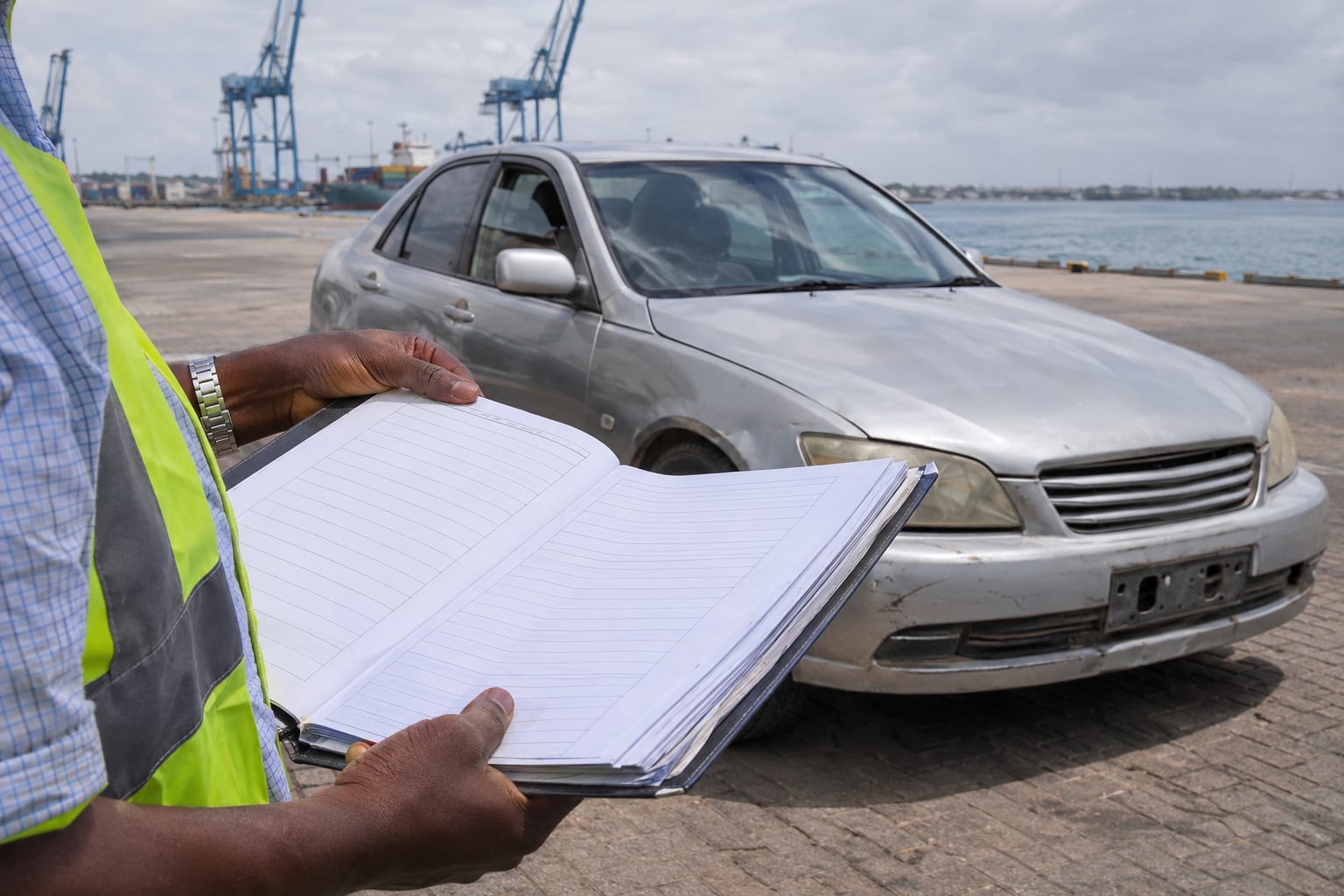 Illustration: An open folder beside a parked saloon car, with port cranes and water in the background.
Where does Carbarn's part end and yours begin?
Carbarn ships its vehicles RoRo to Mombasa, and the car then continues by road into South Sudan. The listed price covers the vehicle and shipping. Every car goes through an EAA pre-shipment inspection in Japan. Port storage, clearance, duty and VAT are not part of it.
Clearance belongs to you or your clearing agent. Carbarn's dashboard shows live vessel tracking and holds the invoice, bill of lading and inspection reports your agent will need. The step-by-step guide to how buying and shipping works sets out each stage from order to arrival at Mombasa.