A car that saves fuel may not be the easiest car to repair when it is far from a suitable workshop. That matters in South Sudan, where town driving, long distances, rainy-season access and fuel logistics can change the ownership equation.
Generic petrol versus diesel advice often assumes smooth roads, short journeys and easy access to specialist technicians. Your decision needs a more practical test. Where will the vehicle drive? How much will it carry? Who can diagnose it when something goes wrong?
This guide compares petrol, diesel and hybrid powertrains for buyers considering a used Japanese vehicle for Juba, Nimule, Yei or longer inter-town routes.
Quick Answer
- Petrol can be a sensible broad choice for private buyers when suitable servicing is available.
- Diesel suits heavy loads, long-distance travel and demanding routes when suitable maintenance is available.
- A full hybrid can reduce fuel use in town traffic, but battery condition and technical support must be checked.
- A 2012 World Bank assessment found less than 5% of South Sudan’s primary roads were in good condition, using an older road benchmark.
Learn how the Japan-to-Mombasa buying process works before comparing vehicles.
Which Fuel Type Is Best for South Sudan Overall?
In its 2012 South Sudan Transport and Road Network assessment, the World Bank found less than 5% of 7,171 kilometres of primary roads were in good condition. That historical figure is not a current road survey. It shows why petrol is often the lower-complexity general-purpose choice for private buyers.
Your route and load matter more than the badge on the tailgate. A family car used around Juba faces a different job from a vehicle carrying cargo between towns. Workshop access, purchase budget, ground clearance, tyre condition and future parts availability all belong in the same decision.
Ground clearance is the space between the lowest point of the vehicle and the road. It matters when a car crosses ruts, stones, flood damage or uneven laterite roads. Tyres, suspension condition, underbody protection and load rating matter alongside that measurement.
The same World Bank assessment described many roads as gravel, dilapidated and mainly inaccessible during rainy seasons. A newer 2025 transport and logistics diagnostic discusses South Sudan’s wider road network, but the network breakdown should be checked against the report’s relevant table before publication.
| Factor |
Petrol |
Diesel |
Full hybrid |
| Best use |
General town and mixed driving |
Heavy loads and long-distance work |
Town traffic and fuel saving |
| Main strength |
Familiar and simpler servicing |
Low-speed pulling power |
Low fuel use in stop-start driving |
| Main concern |
Can use more fuel under load |
Fuel-system and injection complexity |
Battery condition and specialist diagnosis |
| Rough-road fit |
Depends on clearance and condition |
Often suitable for demanding work |
Depends more on the vehicle than the badge |
| External charging needed? |
No |
No |
No for a normal full hybrid |
| Best buyer |
Private driver seeking lower complexity |
High-mileage or load-carrying driver |
Urban driver prioritising fuel economy |
The most useful South Sudan comparison is not “which fuel wins?” It is “which risk can you manage?” Petrol usually brings lower technical complexity. Diesel brings stronger load capability. Hybrid brings lower town-driving consumption, but demands better battery verification.
When Does a Petrol Car Make the Most Sense?
In 2026, *Which? Petrol, diesel and hybrid cars: which is better? reported an average of 42 mpg for tested petrol engines. This UK benchmark is included for broad powertrain comparison only. It does not predict South Sudan consumption, where fuel quality, supply, traffic, air-conditioning, road surface and vehicle condition can differ.
Petrol engines do not depend on charging infrastructure, and servicing familiarity will depend on the workshop and vehicle model. They can suit a family car, small SUV or mixed-use vehicle that spends most of its time around Juba. For moderate annual mileage, the simpler ownership path may matter more than the lowest possible fuel figure.
Petrol is not automatically the best choice for rough roads. Ground clearance, suspension condition, tyre strength, underbody condition and the vehicle’s load rating matter more than whether the engine burns petrol. A well-maintained petrol SUV with suitable clearance may handle a difficult route better than a neglected diesel with worn suspension.
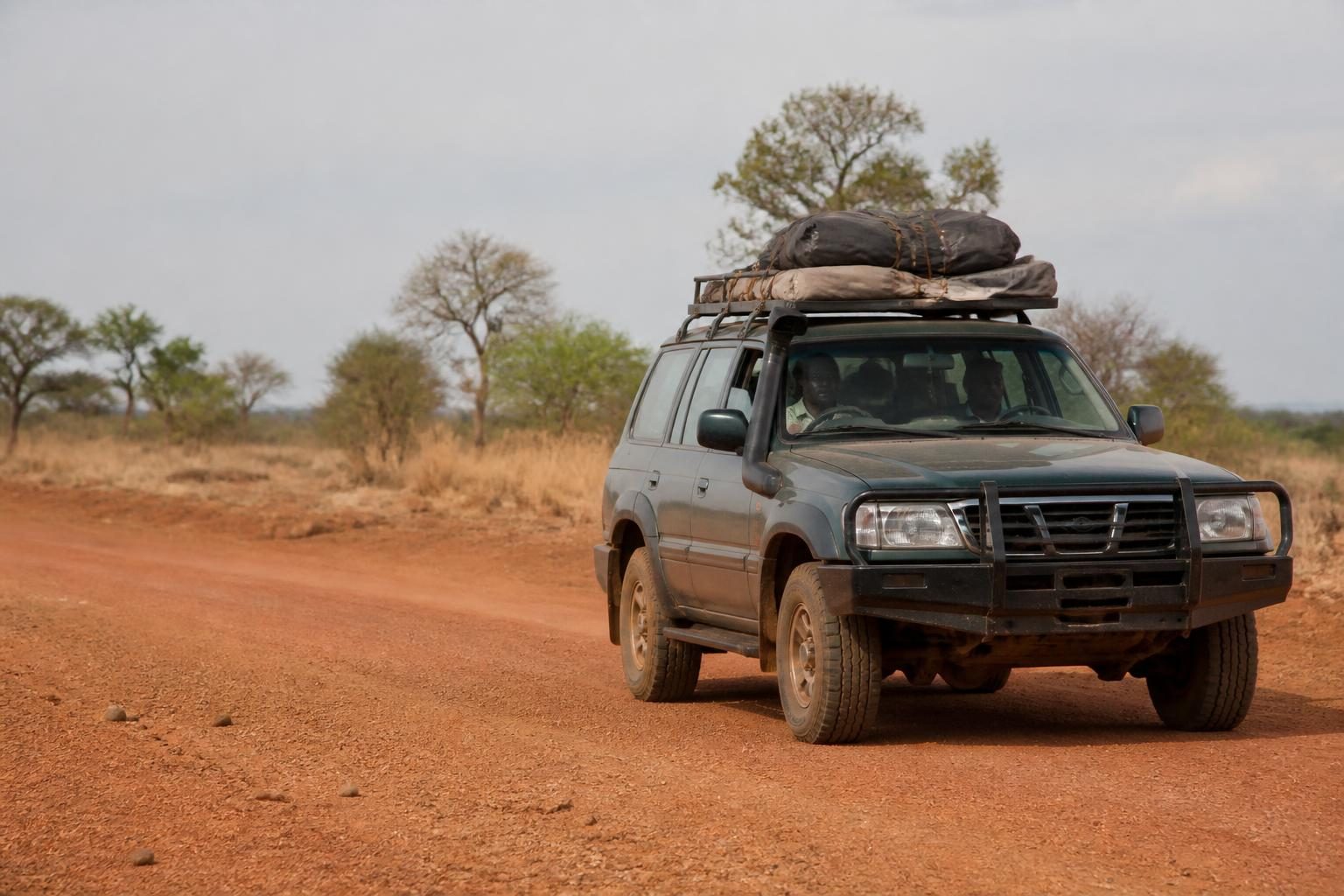 SUV with roof luggage on a red laterite road in dry savannah.
Petrol becomes less attractive when you regularly carry heavy cargo or travel long distances between towns. A thirsty petrol SUV can create a larger running-cost burden, particularly when fuel must travel through difficult transport routes. Still, a simple, well-documented petrol vehicle may offer lower overall risk than a complicated vehicle with an unclear history.
A petrol car is probably the lower-complexity general-purpose choice if you mainly drive in town, carry normal family loads and value straightforward diagnosis.
When Is Diesel the Better Choice?
In 2026, *Which? Petrol, diesel and hybrid cars: which is better? reported an average of 47 mpg for tested diesel engines. This UK result is not South Sudan fuel-economy data. It helps explain why diesel remains attractive for drivers covering distance or carrying heavy loads, but local running costs depend on supply, route and maintenance.
Diesel engines produce strong low-speed pulling power, known as torque. Torque is the turning force that helps a loaded vehicle move. It can help a vehicle leave a stop with passengers or cargo and maintain progress on demanding roads.
Diesel can make sense for business use, passenger transport, cargo work and frequent journeys between Juba, Nimule, Yei or other towns. Before choosing one, check that the intended workshop can diagnose its injection system, turbocharger and related components.
The trade-off is greater maintenance sensitivity in many modern diesels. Fuel injection systems, turbochargers and related components can cost more to diagnose or repair, depending on the model, engine generation, parts supply and technician capability. A diesel used mainly for short trips around town may also deliver less of its main advantage.
South Sudan does have domestic refining capacity. In 2024, the U.S. Energy Information Administration’s Sudan and South Sudan Country Analysis Brief recorded that the Bentiu refinery could produce diesel, gasoline and heavy fuel oil, with nameplate capacity of 10,000 barrels per day. That does not prove consistent retail availability in every town or rural area.
If a vehicle will travel beyond Juba, plan around fuel access rather than assuming every route has a dependable supply. Ask where the vehicle will be refuelled, how far it will travel between stops and whether the chosen engine’s fuel system is suitable for the available maintenance support.
When Can Diesel Become the Wrong Choice?
Diesel may be the wrong choice for light private use, short journeys and buyers without access to a mechanic familiar with diesel systems. A poorly documented diesel can become an expensive project, even if its fuel economy looks attractive on paper.
Diesel is a work-focused recommendation, not an automatic rough-road recommendation. Choose it when the vehicle will carry weight, travel distance and receive suitable maintenance.
Are Hybrid Cars Suitable for South Sudan?
In a 2023 South Sudan Economic Monitor, the World Bank estimated electricity access at 5.3%, including 1.8% connected to the grid and 3.5% using off-grid technologies. That dated figure does not rule out a full hybrid, because a normal full hybrid recharges through driving rather than an external plug.
A mild hybrid uses a small electric system to assist the engine, but normally cannot drive on electric power alone. A full hybrid can use electric power at low speeds and recover energy through braking. Regenerative braking is a system that recovers energy as the vehicle slows. A plug-in hybrid has a larger battery and needs regular external charging to deliver its main benefit.
For South Sudan, a normal full hybrid is generally easier to operate than a plug-in hybrid if you lack reliable access to charging. It does not require a public charging network or dependable household charging. However, the absence of a charging requirement does not remove the need for specialist diagnosis.
One Toyota Aqua Z specification with 195/55R16 tyres is rated at 32.0 km/L under WLTC. Toyota’s original 2011 Aqua launch specification quoted 35.4 km/L under the older JC08 cycle. These figures cannot be compared directly because the test cycles and vehicle specifications differ.
The official figure is a test result, not a promise of South Sudan fuel consumption. Traffic, road surface, air-conditioning use, tyre pressure, vehicle condition and driving style all affect the result.
What Should You Check Before Importing a Hybrid?
Check the battery-health report, warning lights, fault codes, service records and cooling system. Confirm that a suitable technician can diagnose the vehicle and that common service parts can be sourced.
A hybrid is not automatically the cheapest car to own. Its fuel savings can be outweighed by an ageing battery, unclear records or a lack of technical support. A verified full hybrid can suit Juba traffic very well, but it should not be chosen only because its official figure looks impressive.
Use the South Sudan vehicle specification guide to compare verified model details, then ask specifically about battery diagnosis and parts support for the vehicle you are considering.
Factors Beyond the Fuel Badge
In June 2025, the World Bank’s Connecting for Growth: South Sudan Transport and Logistics Diagnostic estimated the country’s road network at approximately 90,200 kilometres. Vehicle condition, ground clearance, parts access and inspection quality can therefore matter more than whether a car is petrol, diesel or hybrid.
Start with the Japanese auction sheet and auction grade. An auction grade is a Japanese auction inspector’s summary of a vehicle’s condition, not a guarantee. Treat it as a buying guide, not a replacement for a detailed inspection.
Check the odometer history, maintenance records, suspension, tyres, underbody, cooling system and air-conditioning. For routes towards Nimule, Yei or other towns, clearance, tyre sidewalls and suspension condition deserve particular attention because they affect how the vehicle copes with ruts, uneven surfaces, extra load and rainy-season access.
Warning lights deserve close attention. Diesel buyers should check engine and fuel-system warnings. Hybrid buyers should request battery diagnostics and confirm the high-voltage system has no recorded faults. Every buyer should look for flood damage, accident repairs and structural concerns.
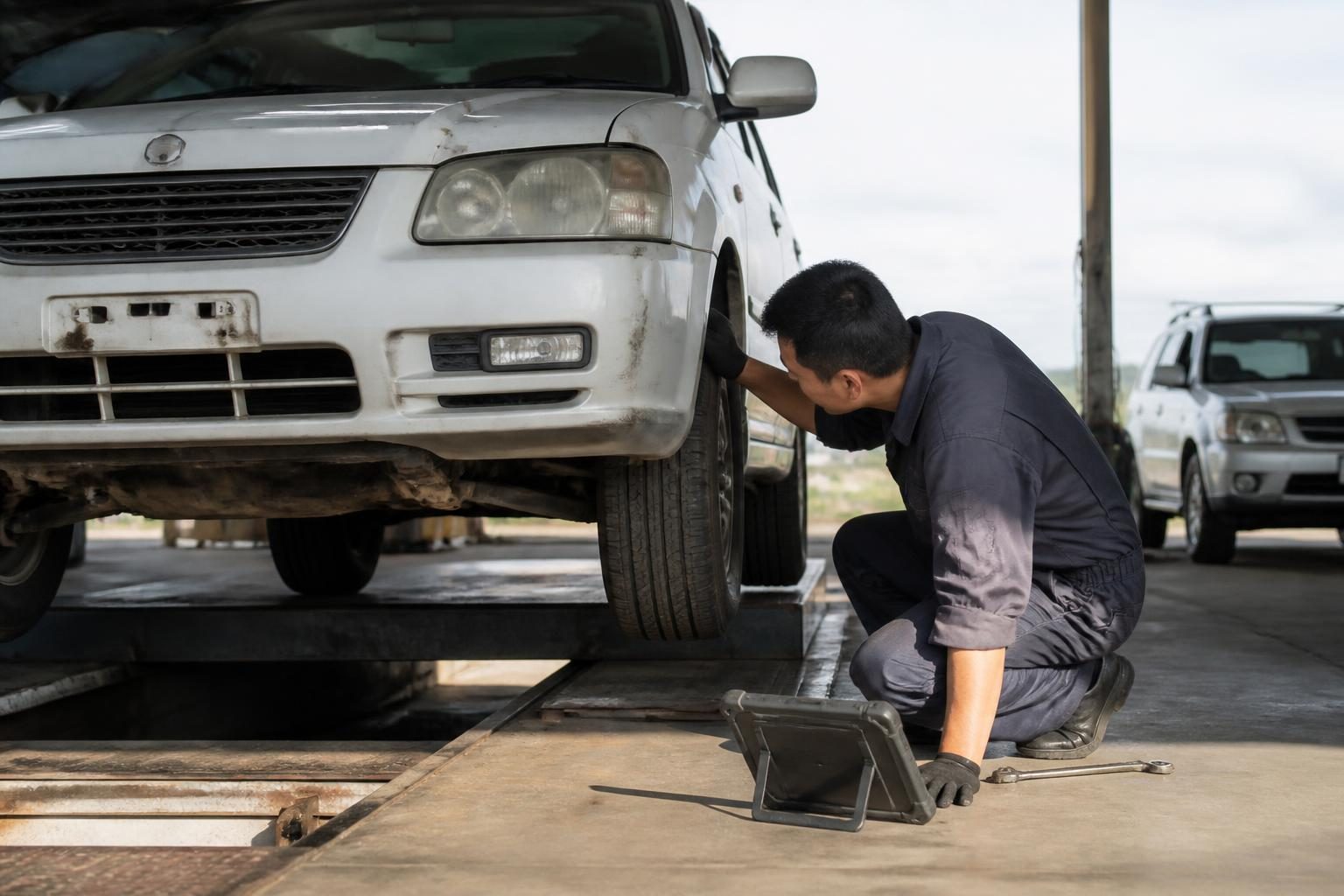 Mechanic inspects the front underbody area of a white car in an inspection bay.
A well-maintained petrol vehicle may be a lower-risk choice than a neglected diesel. A verified hybrid may be better for town traffic than an inefficient petrol car. A low-clearance hybrid hatchback, however, may still be unsuitable for a rough route.
Parts access also deserves a place in the decision. Depending on the model, workshop and local supplier, filters and common suspension parts may be easier to source than specialist hybrid components. Modern diesel injection systems and hybrid battery systems can both require skills that are less available outside Juba.
That does not make hybrids or modern diesels unsuitable. It means the vehicle should match the support available where you live. The South Sudan used-car import requirements should also be checked before you commit to a vehicle.
Which Fuel Type Should You Choose for Your Driving Pattern?
In June 2025, the World Bank’s Connecting for Growth diagnostic described very low truck speeds on surveyed South Sudan logistics routes. That finding shows why route difficulty and load should shape your choice, rather than a generic claim that one powertrain is always cheapest.
Use this buyer-fit framework as a starting point. The scores are editorial guidance, not independent testing. They consider servicing complexity, route suitability, load carrying, likely fuel use and the support needed for each powertrain.
| Use case |
Petrol |
Diesel |
Full hybrid |
| Juba town driving |
5/5 |
3/5 |
5/5 |
| Stop-start traffic |
3/5 |
2/5 |
5/5 |
| Heavy loads |
3/5 |
5/5 |
2-3/5 |
| Frequent inter-town travel |
3/5 |
5/5 |
3/5 |
| Straightforward general servicing |
5/5 |
3/5 |
2-3/5 |
| No charging requirement |
5/5 |
5/5 |
5/5 for a normal full hybrid |
Choose petrol if you mainly drive around Juba, carry normal family loads and want straightforward servicing. It is the lower-complexity choice for many private buyers.
Choose diesel if you regularly carry passengers or cargo, travel long distances and have access to suitable diesel maintenance. It is the work-focused recommendation.
Choose a full hybrid if most driving happens in town traffic, fuel economy is a priority and battery condition has been verified. It is the town-driving recommendation, not a universal winner.
Comparing Japanese Vehicles Before Importing
Carbarn’s buying process guide currently states about 24 to 36 days for shipping from Japan to Mombasa, followed by road transport into South Sudan. That makes inspection and paperwork important before payment, because the journey continues after the vessel arrives.
Carbarn South Sudan vehicles are Japan-based imports, not cars in a local showroom. Each vehicle is shown with its official Japanese auction sheet, auction grade and in-house inspection report before payment. A JEVIC pre-shipment inspection is mandatory and included for South Sudan imports. On arrival, EAA may inspect the vehicle depending on the region.
Vehicles ship by RoRo to Mombasa, then continue by road into South Sudan. The listed price covers the vehicle and shipping, while duty, VAT, customs clearance, registration, licensing and other arrival costs are separate.
Review the South Sudan vehicle inventory or read the South Sudan buying process guide before comparing suitable vehicles.