

Pickup vs SUV for South Sudan Trade Routes: Payload or Comfort?
Read Our Blogs today and Learn More

Moving goods between South Sudanese towns means choosing between two very different strengths. A pickup gives you a working cargo bed. An SUV gives passengers and luggage better protection.
That choice becomes harder when a route changes from asphalt to gravel, potholes, mud or flooded sections. Rain can also make a familiar journey much slower, or temporarily impossible.
This guide compares usable payload, passenger comfort, cargo security, 4WD, ground clearance and maintenance. It also gives you a simple way to choose around the hardest route you regularly drive.
Quick Answer
- Choose for the hardest regular route, not the average journey.
- Choose a pickup for regular heavy, dirty or bulky goods.
- Choose an SUV for passengers, enclosed luggage and long-distance comfort.
- Payload includes people, fuel, tools, accessories and cargo, not cargo alone.
- A 4WD system, suitable tyres, suspension condition and parts support may matter more than body style.
- In its December 2021 joint report with IPIS, the Danish Institute for International Studies described the Juba-Nimule route as about 192 kilometres and reported that around 90% of imports entered through Nimule (DIIS and IPIS, Checkpoint economy: the political economy of checkpoints in South Sudan, ten years after independence, 2021).
South Sudan Trade Routes and Vehicle Demands
South Sudanese trade routes place different demands on vehicles, depending on surface, distance and season. In their December 2021 report, the Danish Institute for International Studies and IPIS described Juba-Nimule as a 192-kilometre trade route carrying about 90% of South Sudan’s imports at that time.
That historical estimate makes the corridor important, but it doesn’t represent every road or current trade flow. Routes towards Yei, Kapoeta, Rumbek and Yambio can involve different surfaces and seasonal problems.
The route also carried significant commercial traffic at the time. The same DIIS report recorded approximately 200 trucks using the Juba-Nimule corridor daily, based on fieldwork between 2019 and 2021. Treat that as dated context, not a live traffic count.
A January to June 2023 report from the Northern Corridor Transport Observatory described deterioration on the Juba-Nimule road at that time. It also identified routes towards Kapoeta, Torit, Yei, Kaya, Rumbek, Maridi and Yambio as undergoing gravel, maintenance or improvement work. Treat this as historical route information, not a current condition report (Northern Corridor Transport Observatory, Biannual Transport Observatory Report, 2023).
A 2019 World Bank transport document, using a 2012 road-network snapshot, recorded 12,642 kilometres of roads. Around 4,000 kilometres were described as all-weather gravel roads, while rural access could become difficult during the April to October rainy season. These are historical figures, not a current road-network measurement (World Bank, Eastern Africa Regional Transport, Trade and Development Facilitation Project, 2019).
Historical route data helps explain the risks, but it cannot predict today’s road conditions. Check current access with local operators, authorities or a clearing agent before committing to a regular route.
Why does the rainy season change the decision?
The rainy season can change which vehicle makes sense because heavy rain affects access, not just comfort. UNICEF reported in 2020 that up to 60% of South Sudan could become inaccessible for approximately six months. UNOPS also explains that roads can wash out, making some journeys slow, expensive or impossible during severe weather (UNICEF, Strategic Prepositioning of Supplies in South Sudan, 2020; UNOPS, Roads to Food Security in South Sudan, accessed 2026).
South Sudan’s trade routes therefore demand more than a general “rough-road” label. The vehicle that works around Juba may not suit a weekly journey through deep mud or damaged gravel.
The practical rule is simple: choose for the hardest regular route, not the average journey. A difficult route travelled once a year shouldn’t dictate everything, but a difficult route travelled every week probably should.
Which Carries More Usable Cargo, a Pickup or SUV?
A pickup is usually the stronger choice when your business depends on regular heavy, dirty or bulky cargo. Payload is the total weight a vehicle can carry, including people, fuel, tools, accessories and cargo. Toyota explains that payload is calculated from GVM minus kerb weight (Toyota Australia, Vehicle Payload, 2026).
| Consideration | Pickup | SUV |
|---|---|---|
| Heavy or bulky goods | Strong advantage | More limited |
| Dirty or wet cargo | Separated from passengers | Can damage the cabin |
| Passenger use | Moderate flexibility | Stronger flexibility |
| Cargo security | Needs a cover or canopy | Enclosed from the factory |
| Repeated payload work | Usually better suited | Easier to overload |
| Passenger comfort | Depends on load and suspension | Usually stronger |
| Family and business use | Good in a double-cab | Usually more flexible |
A pickup bed suits sacks, produce, tools, spare parts, building materials and equipment. You can keep those items away from passengers, although the load still needs proper securing and weather protection.
A single-cab pickup focuses more clearly on work. A double-cab gives you useful passenger space, but the second row takes away some working-bed length. That compromise matters if every trip carries both people and goods.
Usable payload is different from empty cargo space. A large area doesn’t help if passengers, fuel, a canopy, tools and a heavy load push the vehicle beyond its limits.
A canopy, bull bar, roof rack, winch or extra spare tyre can reduce the allowance, depending on its exact mass and fitment. Check the exact vehicle’s GVM, kerb weight, axle limits and owner’s manual before deciding what it can carry.
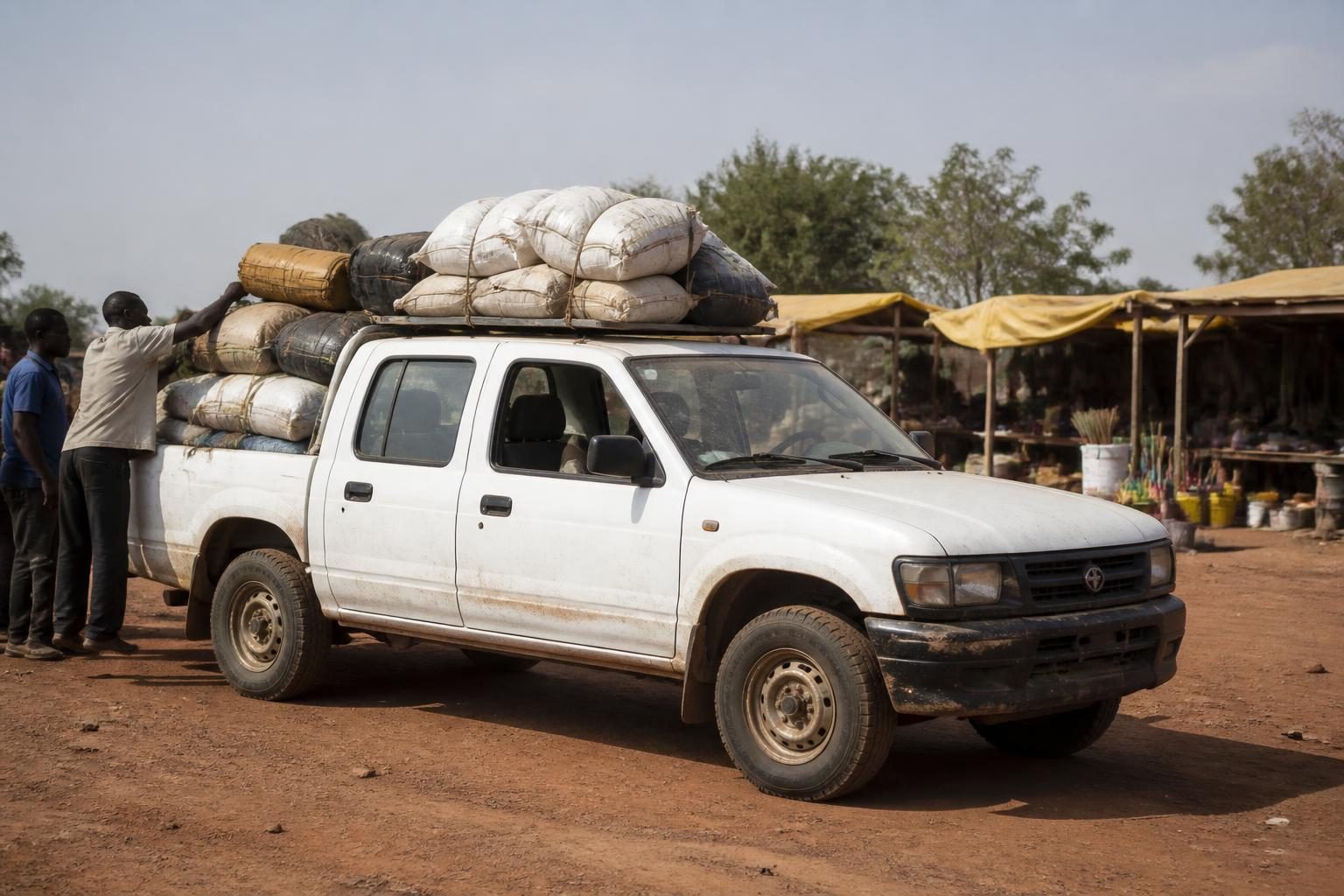
A covered and correctly secured load still counts towards a pickup’s total payload.
Toyota’s payload guidance makes the central point clearly: payload is the vehicle’s total permitted load, not the weight you place in the tray. For trade work, count the driver, passengers, fuel, equipment and cargo together before choosing a vehicle.
Which Is More Comfortable for Long-Distance Driving?
An SUV usually suits passengers better because it keeps people and luggage inside an enclosed cabin. A specified Toyota Fortuner variant lists seven seats and 253 litres of luggage capacity, showing the trade-off: seven seats don’t automatically mean generous luggage space (Toyota Senegal, Fortuner Specifications, 2026).
An SUV keeps passengers and luggage inside an enclosed cabin. That helps with dust, rain and heat, especially when people spend many hours travelling between towns.
Documents, clothing, food and smaller equipment are also easier to protect inside the vehicle. A pickup needs a canopy, lockable box or strong cover to provide similar protection.
The trade-off is space. When every seat is occupied, an SUV’s luggage area can shrink quickly. Passengers may end up sharing footwells with bags, which reduces comfort and can become unsafe if cargo is not secured.
Comfort also depends on the individual vehicle. Tyre sidewall, seat design, suspension condition and vehicle age can matter more than the SUV badge.
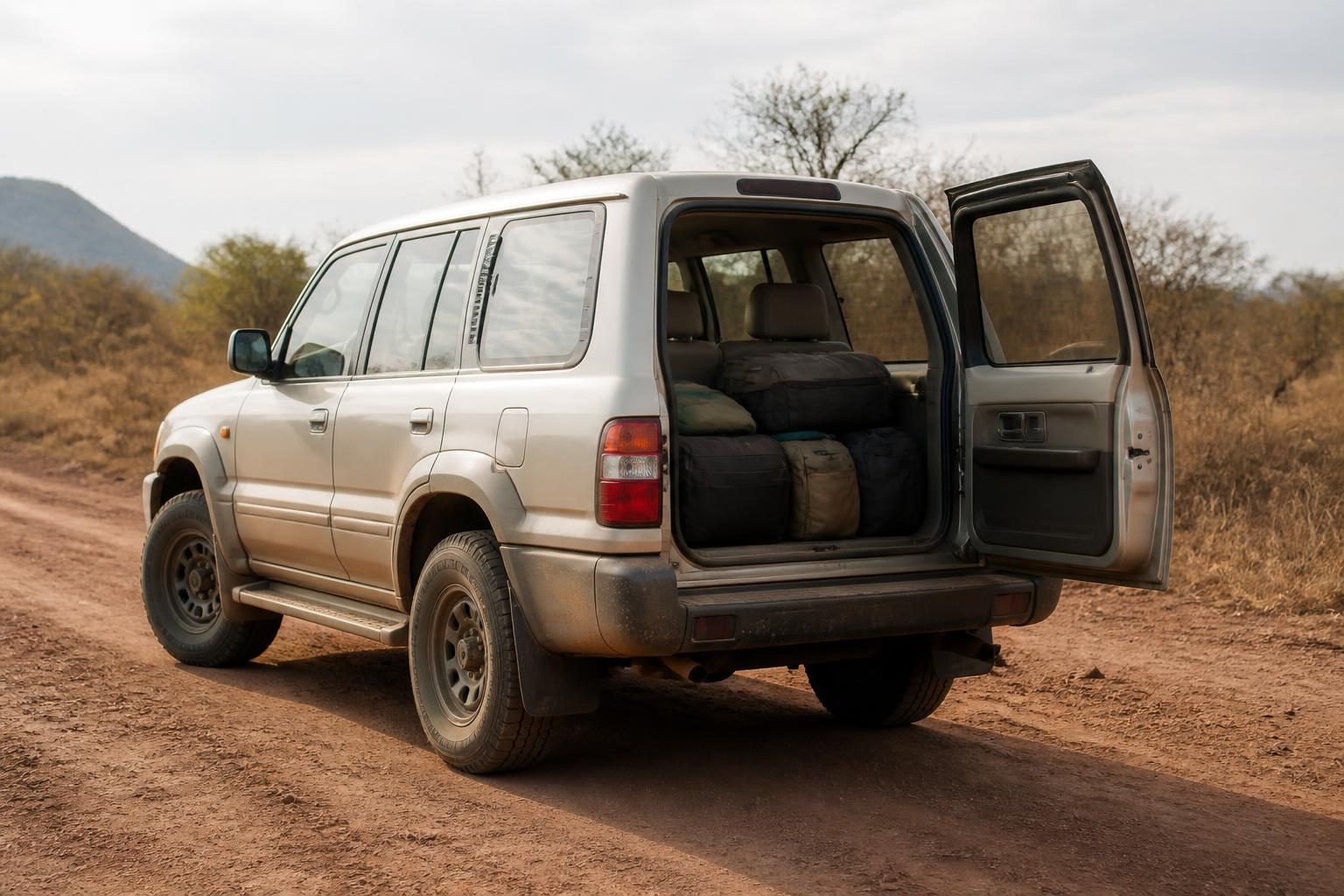
An SUV protects passengers and luggage, but the available cargo space falls when all seats are occupied.
One specified Fortuner example has seven seats but only 253 litres of luggage capacity. That variant-specific figure is a useful warning for families, staff transporters and traders: check the exact seating and cargo layout before importing.
Which Road and Ownership Factors Matter Beyond Body Style?
The exact drivetrain, clearance, tyres and suspension matter as much as the body style. Toyota Senegal’s currently listed Fortuner variants include one with 279 millimetres of ground clearance, while an older Toyota Uganda document lists 215 millimetres for a specified Prado variant. These market- and variant-specific figures show why clearance must be checked by year and variant (Toyota Senegal, Fortuner Specifications; Toyota Uganda, Prado Specifications, accessed 2026).
Ground clearance is the space between the lowest part of the vehicle and the road. It helps with ruts, rocks and standing water, but it doesn’t guarantee access through deep mud or floodwater.
Check whether the exact variant has genuine 4WD and low-range gearing where the route requires it. Low-range gearing is a slower drivetrain setting that increases control and wheel torque on difficult terrain. A high-riding two-wheel-drive vehicle may still struggle when traction disappears.
Tyre sidewalls matter too. Taller sidewalls can offer more protection from sharp stones and damaged surfaces than low-profile tyres. Worn tyres reduce braking, steering and recovery confidence.
Suspension condition deserves close attention. Sagging rear springs can reduce clearance under load, while worn dampers can make a long trip tiring and less stable.
Think about recovery equipment as well. Check recovery points, spare-wheel access and whether accessories have reduced the remaining payload. A heavy roof rack or canopy may be useful, but it isn’t weightless.
Fuel use should be checked against the exact engine, year and test cycle. Don’t transfer a Japanese-market figure from one generation to another. Heavy loads, poor surfaces and long distances can also increase real-world consumption.
Cargo security creates a different trade-off. A pickup bed needs practical protection from rain and casual theft. An SUV protects goods better, but dirty tools or sharp equipment can damage the interior.
For demanding routes, low-slung urban crossovers, luxury SUVs with expensive equipment and two-wheel-drive vehicles may offer poor value when the route needs clearance, simple servicing and dependable recovery options. Simpler mechanical layouts and parts support can matter more than premium features.
According to Toyota’s payload guidance, every accessory reduces the weight available for useful cargo. The right vehicle therefore combines suitable 4WD, tyres, clearance and suspension with enough remaining payload for the actual job (Toyota Australia, Vehicle Payload, 2026).
Which Body Type Fits Your Work?
The best starting point depends on the job, not the badge. Rainy-season access deserves particular weight in your decision because heavy rain can make roads slower or impassable.
| Your work pattern | Better starting point | Why |
|---|---|---|
| Produce, tools or building materials every week | Pickup | Separates cargo from passengers |
| Passenger transport between towns | SUV | Better seating and weather protection |
| Family use plus occasional business travel | SUV | Flexible cabin and enclosed storage |
| Heavy loads on repeated routes | Pickup | Better load access and payload focus |
| Mostly Juba driving with occasional rural trips | SUV or double-cab pickup | Depends on the passenger and cargo balance |
| Rainy-season field work | Proper 4WD pickup or SUV | Traction, clearance and recovery equipment matter |
| Light goods with strong security concerns | SUV | Enclosed luggage is easier to protect |
Use this five-question worksheet before looking at individual vehicles:
- How much cargo do you carry during a normal week?
- How many passengers travel on your longest regular route?
- How much cargo remains when every seat is occupied?
- Which route becomes most difficult during rain?
- Can a mechanic or clearing agent support the exact variant?
A Hilux, Fortuner, Prado, D-Max or Navara badge doesn’t answer those questions by itself. Year, drivetrain, condition, auction grade, inspection results, tyres, suspension and parts support still need checking.
| Vehicle | Likely cargo role | Seating | 4WD availability | Parts and inspection focus |
|---|---|---|---|---|
| Hilux | Regular goods, tools and materials | Variant-dependent | Variant-dependent | Check payload, chassis, suspension and exact drivetrain |
| Fortuner | Passengers with occasional cargo | Seven seats on the specified example | Variant-dependent | Check luggage space, 4WD system and service history |
| Prado | Passenger travel on demanding routes | Variant-dependent | Variant-dependent | Check clearance, underbody, suspension and electronics |
| D-Max | Work-focused cargo use | Variant-dependent | Variant-dependent | Check payload, load condition and parts support |
| Navara | Mixed business and passenger use | Variant-dependent | Variant-dependent | Check exact variant, payload, chassis and 4WD operation |
The table is a starting point, not a substitute for checking the individual Japanese-market vehicle. Confirm the exact year, model code, drivetrain, seating layout, auction sheet, inspection report and parts situation before choosing.
If passengers are the main load, an SUV probably makes more sense. If goods are the main load, a pickup is the clearer starting point.
Comparing and Importing the Right Vehicle Type
Import the vehicle that matches your actual load and route, then verify the exact Japanese-market example before payment. Right-hand-drive vehicles are eligible under the published guidance, but confirm registration and enforcement requirements with the relevant South Sudan authority before buying. Traffic directives have changed before.
The published process estimates about 24 to 36 days from Japan to Mombasa (South Sudan import rules, 2026). Road transport into South Sudan follows arrival at Mombasa.
Carbarn’s South Sudan service information describes vehicles being sourced in Japan and shipped via Mombasa, rather than bought from a local Juba showroom. Compare the individual vehicle’s auction sheet, auction grade, odometer, variant, drivetrain and in-house inspection report.
Check the underbody, suspension, tyres, engine and 4WD operation. JEVIC pre-shipment inspection is mandatory for South Sudan and is included. Separately, EAA may perform a roadworthiness inspection on arrival, depending on the region.
The import cost flow is easier to understand in stages:
- Vehicle and shipping: The listed price covers the vehicle and shipping.
- Japan to Mombasa: Weekly MSC RoRo departures are used, with an estimated transit time of about 24 to 36 days.
- Road transport: The vehicle then travels from Mombasa into South Sudan.
- Duty and VAT: These are separate from the listed price and vary with the vehicle and destination.
- Arrival costs: Customs clearance, inspection, registration and licensing are also separate costs.
The site also displays a separate 40-day shipping summary. Treat the Japan-to-Mombasa estimate as indicative and confirm the current timeline before payment.
The listed price covers the vehicle and shipping. Duty, VAT, customs clearance, registration, licensing and other arrival costs are separate. Carbarn’s published rules identify VAT as 20% of the dutiable value, but assessment bases and current charges can change. Confirm the payable amount with South Sudan Customs or a licensed clearing agent. Customs duty varies by vehicle specification and destination, including Juba, Yei and Nimule, so don’t rely on one universal rate (South Sudan import rules, 2026).
Use the browse Japanese vehicles for South Sudan page to compare available categories. You can also review Toyota vehicles for comparison, Isuzu vehicles for cargo work and Toyota specifications and dimensions.
The Japan import process page explains the process, while the South Sudan import rules and costs page covers eligibility and destination-related charges.
The bottom line: choose a pickup when regular heavy, dirty or bulky goods drive the business. Choose an SUV when passengers, protected luggage and long-distance comfort matter more. In either case, the hardest regular route should set the requirement.
Frequently Asked Questions (FAQs)

Related Cars


Jason Sildir
Passionate Automotive Blogger
I am a Turkish-Australian automotive writer with a passion for hybrid vehicles and rugged 4WD adventures. My writing combines detailed technical insights with a love for outdoor exploration and Aussie driving culture. Having guest posted for leading automotive sites, my mission is to educate and inspire drivers considering greener and tougher vehicle options.

Published Date
September 5, 2026