Transit cargo bound for South Sudan through Mombasa fell 43% in the first half of 2026, according to the Northern Corridor biannual report covering January to June 2026. Table 3 of that report puts the total at 446,802 tonnes, down from 778,982 tonnes a year earlier. If you're about to order a car from Japan, that headline can make you pause. South Sudan is landlocked, so most of what you import lands at a Kenyan port first and then travels north by road.
Transit cargo means goods landed at Mombasa and moved on to another country. A tonne is simply a measure of weight.
Quick Answer
- Transit cargo to South Sudan via Mombasa fell 43% to 446,802 tonnes in Jan–Jun 2026, from 778,982 tonnes, according to the Northern Corridor biannual report (Table 3).
- The figure counts all cargo by weight. It isn't a measure of car shipments.
- It can't show how any single car shipment fared, or what it cost.
- If you're about to order, confirm routing, documents and your clearing plan before you pay.
What does the report actually say?
The report gives two half-year totals for South Sudan-bound transit cargo through Mombasa and the change between them. Cargo fell from 778,982 tonnes in the first half of 2025 to 446,802 tonnes in the first half of 2026. That's a drop of 332,180 tonnes, or about 42.6%, which rounds to 43%.
| Period |
Transit cargo to South Sudan |
Change |
| Jan–Jun 2025 |
778,982 tonnes |
baseline |
| Jan–Jun 2026 |
446,802 tonnes |
down 332,180 tonnes (about 43%) |
The same table shows South Sudan took 5% of all transit cargo through Mombasa in the half-year, against 71% for Uganda. Total transit cargo through the port rose 13% to a record 8.34 million tonnes, so South Sudan's fall went against the trend.
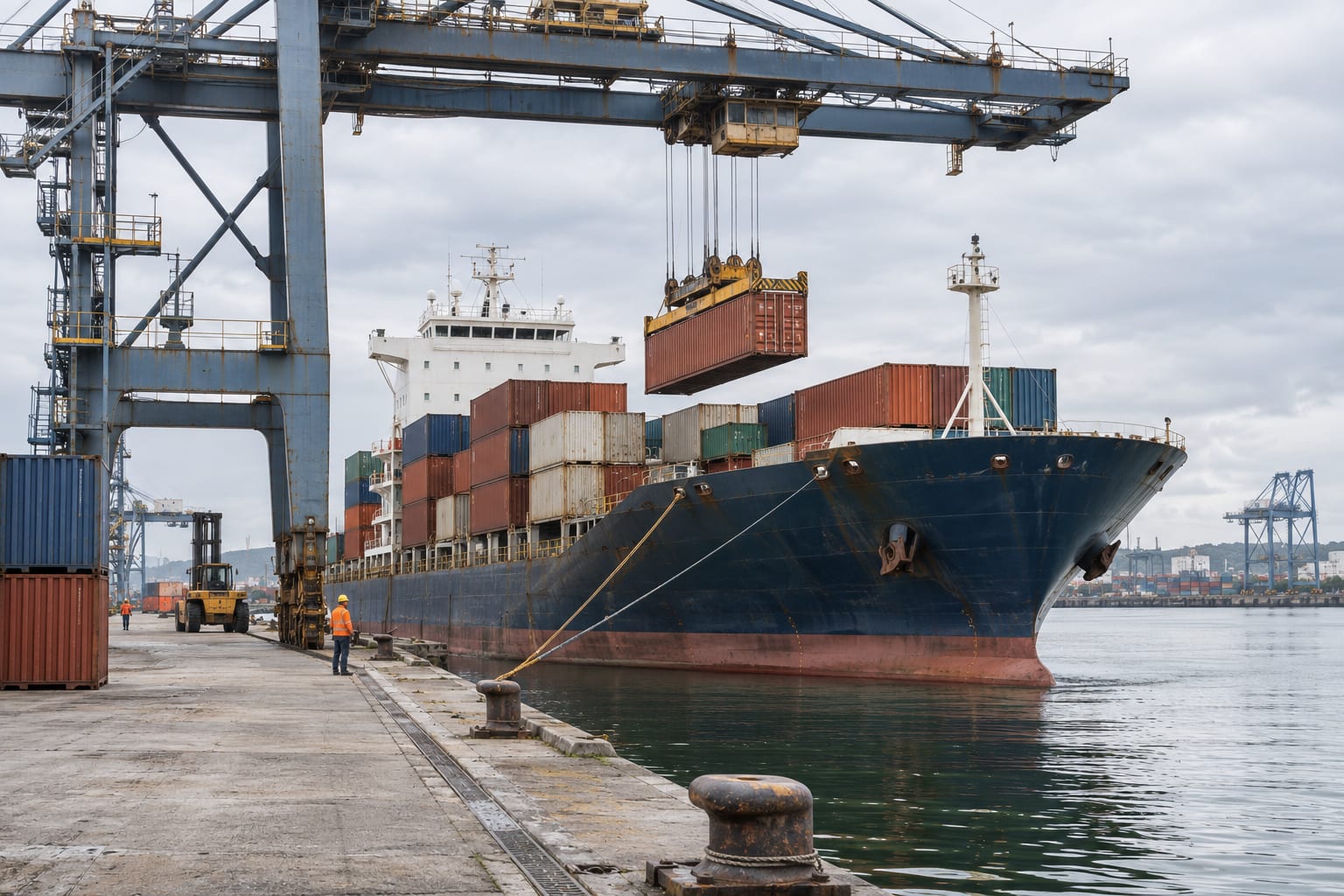 Illustration: A crane handles a shipping container above a moored cargo ship.
Why might cargo have fallen?
The report gives its own reasons. It says the fall "was partly attributed to contraction of South Sudan economy and changes in the tax regime at the port of entry", which led some cargo owners to declare consignments to neighbouring countries first and ask to change the destination to South Sudan while the cargo was already in transit.
That second point matters for reading the figure: cargo first declared to a neighbouring country is counted under that country in the table, so part of the fall may be cargo that still reached South Sudan under another declaration. The report gives no size for that effect.
How does a car from Japan reach South Sudan?
A car bought from a Japanese exporter follows four steps: order, inspection, sea, then road.
- Order and pay. You receive a proforma invoice, which is the formal quote you pay against. It lists the car details and the CIF value, meaning cost, insurance and freight.
- Pre-shipment inspection. The inspection in Japan is included in the price.
- RoRo sailing to Mombasa. RoRo stands for roll-on/roll-off: the car is driven onto a vessel rather than packed in a container.
- Road transport into South Sudan. The car is collected at Mombasa and trucked or driven inland.
The quoted price covers the car, the shipping and the pre-shipment inspection, and nothing after that. Customs clearance, duty and taxes, registration and licensing are all paid in South Sudan.
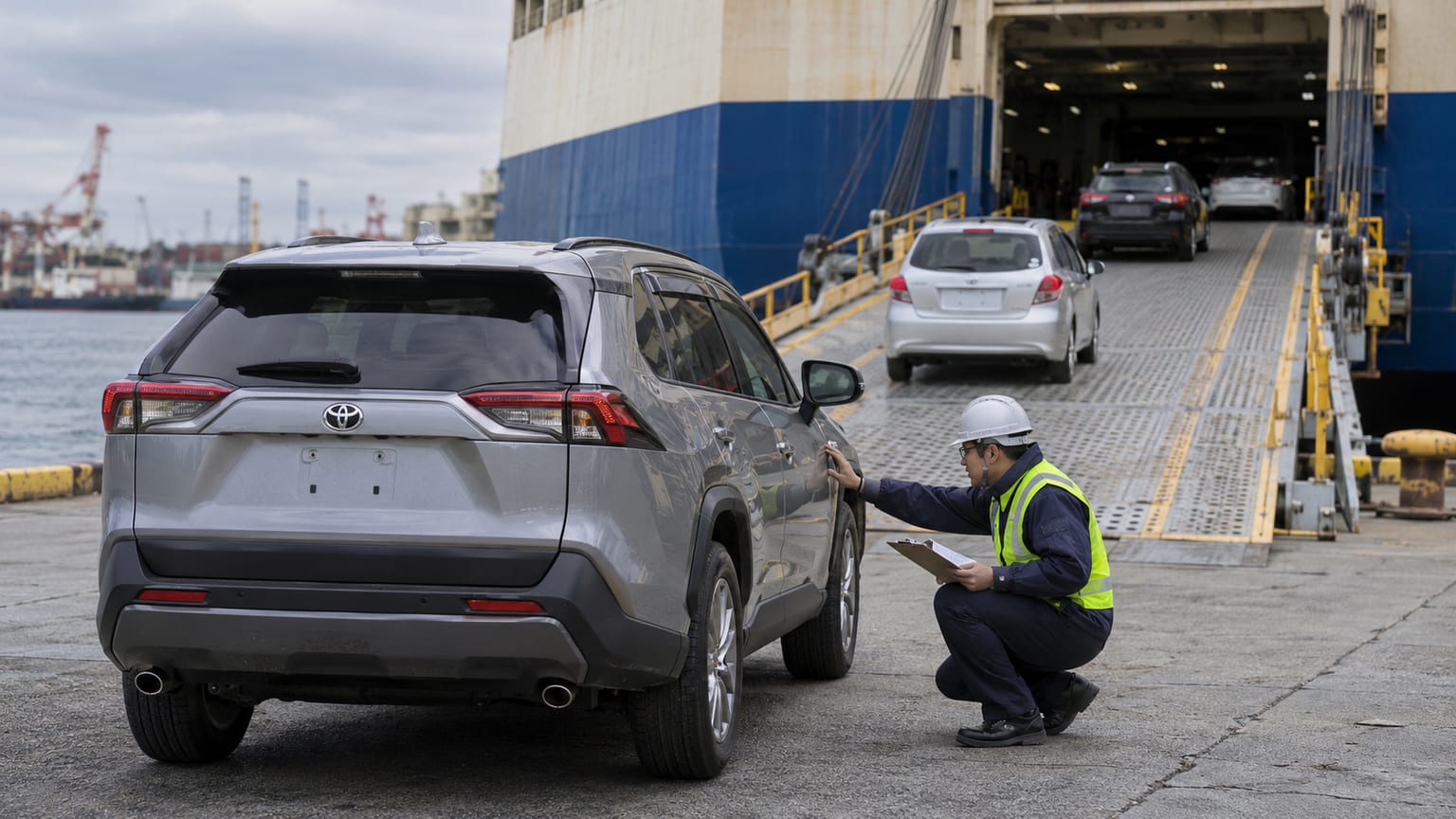 Illustration: An inspector checks a Toyota RAV4 while cars board a roll-on/roll-off ship.
What should you check before you order?
Four checks protect your order far better than watching cargo statistics. They cover the invoice you pay against, the person who clears your car, the town it enters through, how you track the ship.
- Read the proforma invoice line by line. Confirm the chassis number, year, model and the CIF value. An error here follows you to the border.
- Appoint a clearing agent early. A clearing agent is the licensed person who handles customs paperwork on your behalf. Line one up before the ship sails, not when it docks.
- Ask which destination town your car will clear through. Your clearing agent can tell you what that town's clearance involves.
- Track the shipment yourself. Keep copies of the invoice and bill of lading, and follow the vessel on live tracking.
 Illustration: reviewing vehicle shipping paperwork beside a laptop showing a shipping route.
Where does Carbarn fit?
Carbarn is a Japan-based car exporter. Each listing comes with two reports before you pay: the official Japanese auction sheet and a Carbarn inspector report. The price covers the car, shipping to Mombasa and the pre-shipment inspection.
Payment is by bank transfer against a proforma invoice, and the dashboard holds your invoice, bill of lading and live vessel tracking. The how to buy page walks through each step.
What this does not show
A half-year tonnage total tells you almost nothing about a single car. It measures all transit cargo by weight, so heavy bulk goods can move the number far more than vehicles do.
It also says nothing about car prices, how long any one shipment took, or how any one exporter or shipping line performed.
The report's reasons are its own description, not a measurement: it does not say how much of the fall each one caused.
Method and sources
- Northern Corridor Transit and Transport Coordination Authority, Northern Corridor Biannual Report, January to June 2026, Table 3 "Transit Cargo Throughput at the Port of Mombasa" (source line: Kenya Ports Authority): South Sudan 778,982 tonnes in Jan–Jun 2025 and 446,802 tonnes in Jan–Jun 2026, a change of -332,180 tonnes or -43%, and a 5% share; Uganda 71%; total transit cargo 8.34 million tonnes, up 13%. The reasons quoted come from the report's text. Checked 21 November 2026.