Buying a Toyota Corolla Fielder Hybrid in South Sudan often means choosing between easy daily driving and enough clearance for difficult roads. A large SUV may handle poor surfaces better, but it can cost more to buy and run. A low wagon can be easier around Juba and more practical than a sedan.
The Toyota Corolla Fielder Hybrid sits in that middle ground. It has five seats, useful luggage space and a petrol-electric drivetrain. This guide explains whether its economy outweighs its low ground clearance for severe roads, how the hybrid suits local driving, and what to check before importing one in 2026. For eligibility and document guidance, see the South Sudan import rules and requirements.
Quick Answer
- The Corolla Fielder Hybrid suits buyers who mainly drive around Juba or on maintained roads.
- Toyota lists 33.0 km/L on the JC08 cycle for the 2013–2014 NKE165G; the later 2024–2025 model is rated at 27.8 km/L WLTC.
- Its low ground clearance is workable for ordinary urban use, but not deep ruts or regular off-road driving.
- Five seats and a wagon body make it useful for family errands.
- Check the hybrid system, auction sheet, suspension, tyres and underbody before payment.
| Vehicle type |
Main strength |
Main compromise |
Likely South Sudan fit |
| Corolla Fielder Hybrid |
Economy, five seats and wagon space |
Low clearance and 2WD |
Juba commuting and family use |
| Corolla Axio Hybrid |
Compact sedan format |
Less flexible luggage space |
Urban driving with lighter cargo |
| Toyota Probox |
Work-focused practicality |
Less passenger-car comfort |
Business loads and simpler utility |
| Toyota RAV4 or similar SUV |
More clearance |
Usually higher fuel use and cost |
Rural routes and difficult roads |
What is the Toyota Corolla Fielder Hybrid?
The Toyota Corolla Fielder Hybrid is a five-seat, front-wheel-drive petrol-electric wagon. In Toyota’s 2024–2025 model period, the NKE165G used a 1.496-litre petrol engine, 54 kW, 111 Nm and an electric continuously variable transmission (Toyota Corolla Fielder official specifications, 2025).
A wagon gives you a longer roof and more flexible luggage space than a sedan. Toyota’s Japanese Fielder catalogue records approximately 407 litres with five passengers and 872 litres with the rear seats folded, using its VDA measurement method (Toyota Corolla Fielder official specifications, 2013). That suits shopping, family bags and moderate business use.
The lower body also matters. You sit closer to the road than in an SUV, and the wagon’s long shape does not help when crossing deep ruts. Exact equipment varies by model year, grade and individual vehicle, so don’t assume every Fielder has identical safety features, screens or interior trim.
2014 Toyota Corolla Fielder Hybrid, the shortlisted example
The 2014 Toyota Corolla Fielder Hybrid is a useful example of what a South Sudan buyer may compare. Its record identifies model code NKE165G, hybrid power, a wagon body, five seats, 2WD, 40,000 km and auction grade 3.5 (2014 Toyota Corolla Hybrid vehicle record, 2014).
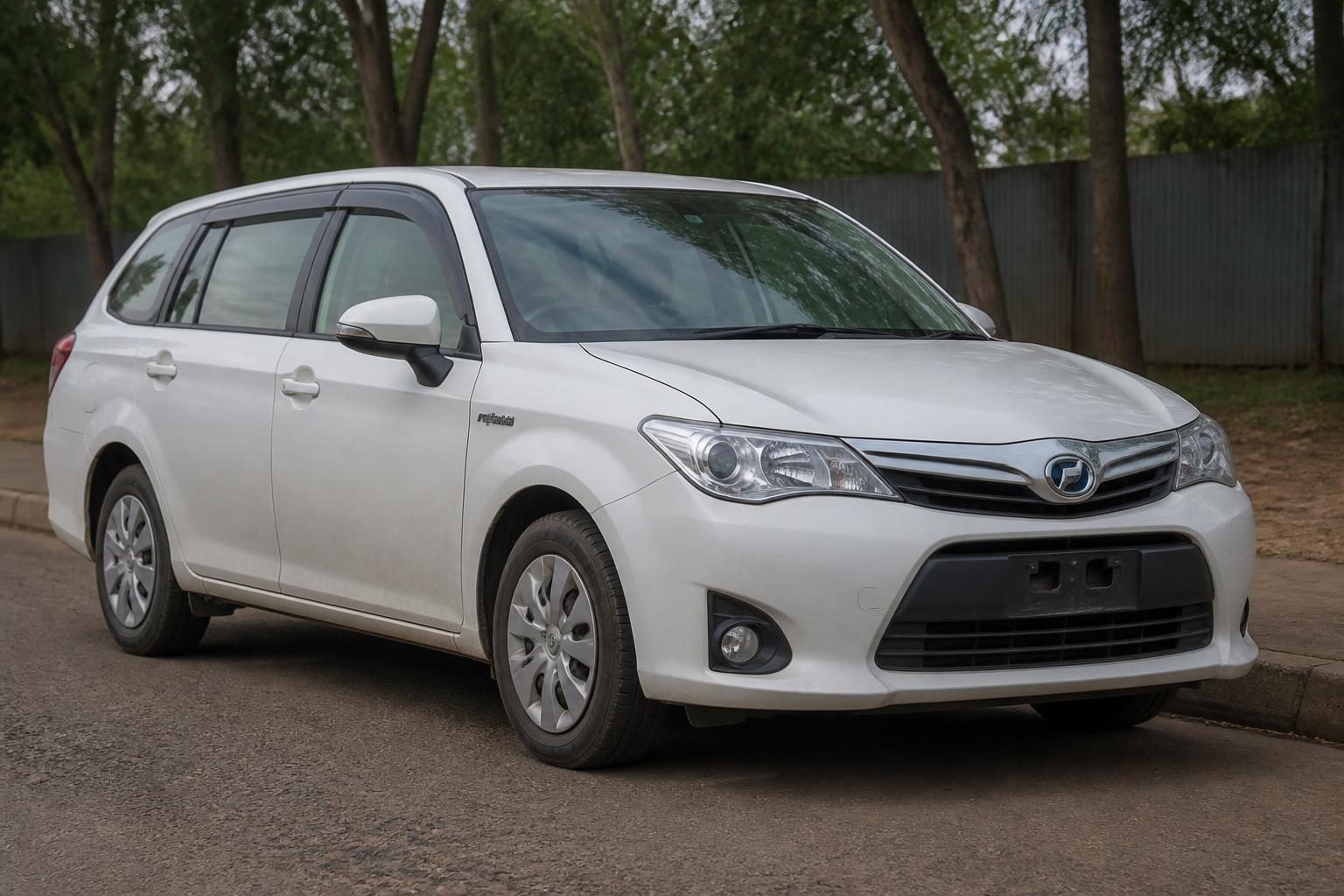 2014 Toyota Corolla Fielder Hybrid
An auction grade is a Japanese auction assessment of a vehicle’s recorded condition. It is useful evidence, but it isn’t a complete mechanical guarantee. For this 2014 NKE165G, Toyota lists a 1,180 kg vehicle weight, a 36-litre fuel tank and front-wheel drive. Always match the individual auction sheet and inspection report to the actual vehicle.
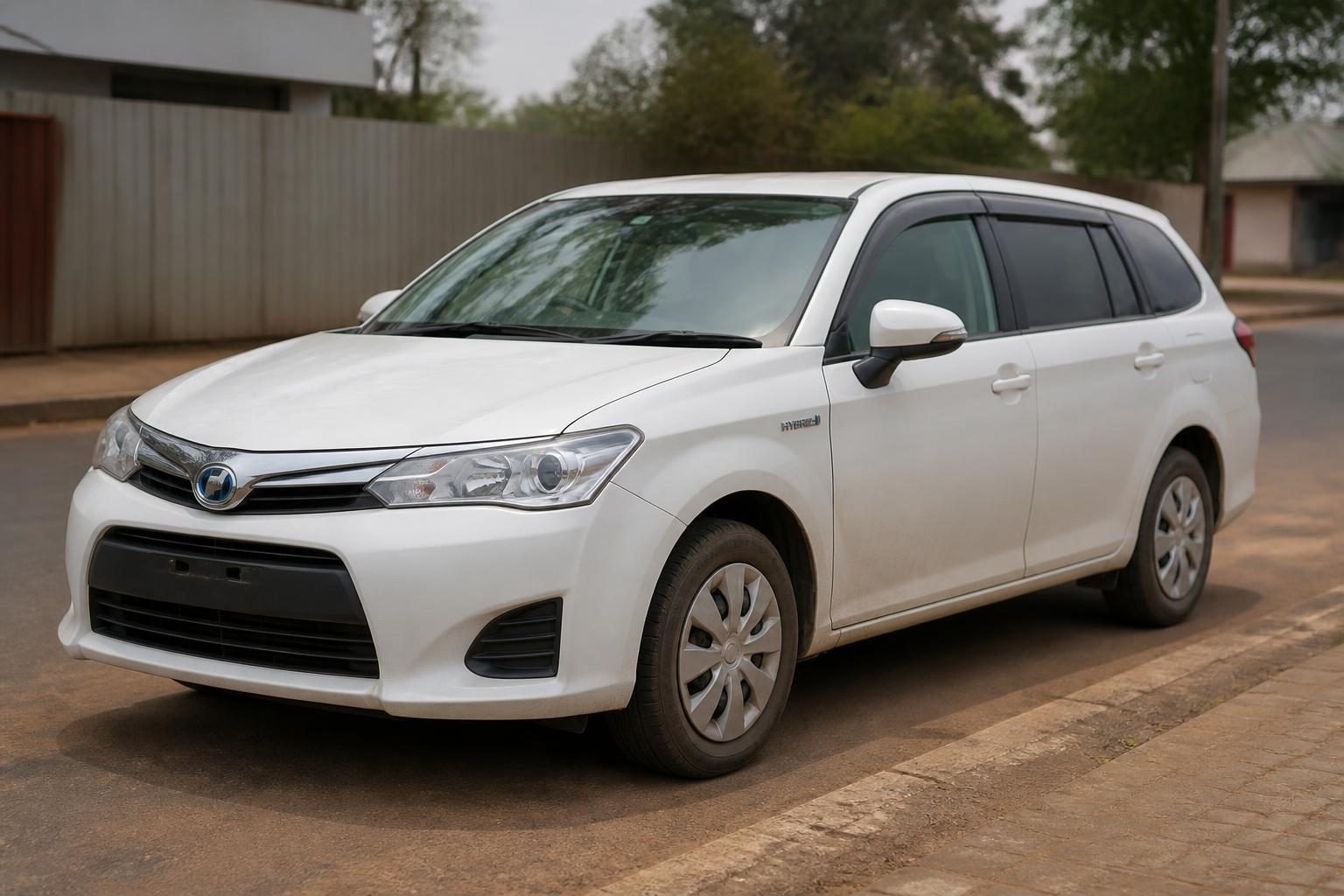 2014 Toyota Corolla Fielder Hybrid
Toyota’s Japanese catalogue records the latest model period through November 2025 (Toyota Corolla Fielder used-car catalogue, 2025). Therefore, “2026” describes when you buy or import one. It does not describe a new 2026 model year.
The later 2024–2025 specification is shown for comparison. The shortlisted vehicle is a 2014 model, so its equipment and economy should be assessed against its own specification.
Browse Toyota specification information before comparing grades or model years.
How economical is the Corolla Fielder Hybrid?
For the later 2024–2025 model, Toyota lists the NKE165G Hybrid EX at 27.8 km/L on the WLTC combined cycle (Toyota Corolla Fielder Hybrid EX vehicle information, 2024). The 2014 example belongs to the earlier model period, which Toyota rates at 33.0 km/L on the JC08 cycle. These test results are not promises of real-world consumption.
JC08 is an older Japanese fuel-economy test cycle. WLTC is a newer test cycle designed to represent urban, suburban and highway driving. Because the tests use different methods, the 33.0 km/L JC08 result and 27.8 km/L WLTC result should not be treated as a direct year-on-year comparison.
| Test condition |
Official result |
| WLTC combined |
27.8 km/L |
| Urban cycle |
24.6 km/L |
| Suburban cycle |
30.8 km/L |
| Highway cycle |
27.6 km/L |
Toyota says weather, traffic, driving style and air-conditioning can change actual results. Strong air-conditioning, dusty roads, low-speed crawling, heavy loads and poor tyre pressure can all increase fuel use.
The hybrid system may show its greatest advantage in stop-start Juba traffic, where braking helps recover energy. On a fast, rough intercity journey, that advantage may be smaller because the petrol engine works more consistently and road resistance rises.
A 36-litre tank also keeps the vehicle compact and light, but it gives you less fuel reserve than many larger SUVs. Check the tank, fuel system and service history carefully if the vehicle will travel long distances between reliable fuel stops.
Is the Corolla Fielder Hybrid suitable for South Sudan roads?
The Fielder can suit Juba and maintained roads, but its low ground clearance limits severe-road use. The later model is 4,400 mm long and 1,695 mm wide, with a 4.9 m minimum turning radius. The 2014 model is 4,360 mm long; its turning radius is also 4.9 m (Toyota Corolla Fielder official specifications, 2025).
That compact size is useful for commuting, errands and airport trips. Five seats and a wagon load area make it practical for ordinary family errands, shopping and moderate luggage.
The trade-off is the underbody. Front-wheel drive can work on firm roads, but it gives you less confidence in deep mud than a suitable four-wheel-drive vehicle. A low wagon can also touch the ground in deep ruts, flood damage or rocky sections.
Good fit:
- Juba commuting and family errands.
- Maintained intercity roads.
- Airport and town driving.
- Light business use.
- Occasional moderate unsealed roads with careful driving.
Poorer fit:
- Deep mud or flooded sections.
- Rocky tracks and severe ruts.
- Heavy cargo.
- Regular remote-area travel.
- Routes where clearance matters more than fuel economy.
Toyota Corolla Fielder listings in South Sudan
What should you check before importing one?
The shortlisted example is a 2014 model with 40,000 km and auction grade 3.5, but those figures cannot confirm the current hybrid battery, suspension or underbody condition (2014 Toyota Corolla Fielder Hybrid G vehicle record, 2014). A proper inspection must look beyond the grade.
Before payment, check:
- The NKE165G chassis code, right-hand-drive layout and current import eligibility with EAA or the relevant authority.
- The auction sheet for repairs, corrosion, replacement panels and interior damage.
- The inspection report and odometer evidence.
- Hybrid warning lights on the dashboard.
- Unusual noise from the battery cooling fan.
- Hybrid-system diagnostic results.
- Suspension, steering, brakes and tyres.
- Underbody damage from previous road impacts.
- Air-conditioning performance.
- Service records and documents supplied before payment.
A practical export inspection should pay close attention to battery warnings, cooling-fan noise, suspension knocks, underbody scrapes and auction-sheet repair markings. These checks matter more than a clean photograph, especially when you cannot inspect the vehicle in person before shipping.
EAA is the authority involved in the South Sudan vehicle inspection process. Its mandatory pre-shipment inspection is included. The inspection provides useful export evidence, but it does not replace reading the auction sheet or individual inspection report.
On arrival, EAA may perform a roadworthiness inspection during customs clearance, depending on the region. Confirm the required documents and current procedure through the South Sudan buying process.
What will it cost to bring a Corolla Fielder Hybrid to South Sudan?
The vehicle price is only one part of the final landed cost. Landed cost means the total amount after purchase, shipping, clearance and other applicable charges. Tax treatment must be confirmed for the vehicle, customs value and destination town before payment.
Do not treat an older online tax reference as a universal 2026 calculation. Ask a qualified clearing agent or the relevant South Sudan authority for the current assessment.
Budget separately for:
- The vehicle purchase price, quoted in USD.
- Japan-side documents and inspection.
- RoRo shipping from Japan to Mombasa.
- Customs duty and applicable taxes.
- Customs clearance and clearing-agent charges.
- Road transport from Mombasa into South Sudan.
- Arrival inspection, where applicable.
- Registration and licensing.
Do not call a vehicle listing price the landed or on-road total. Duty and tax treatment can vary with the vehicle specification and destination town, including Juba, Yei or Nimule. The final amount also depends on the customs value and clearance process.
Avoid relying on an old online estimate. Ask for a vehicle-specific calculation, confirm the destination, and review the South Sudan import rules and requirements before making a payment.
Toyota Corolla Fielder Hybrid buyer fit
The Fielder Hybrid makes the most sense for a buyer who values fuel economy and daily practicality more than clearance or heavy-load capacity. Toyota lists a 4.9 m minimum turning radius and five seats, which support easy town driving and ordinary family use (Toyota Corolla Fielder official specifications, 2025).
Strong fit
- You mainly drive around Juba.
- You carry up to five people.
- You want a smaller Toyota.
- You need flexible wagon luggage space.
- You value lower petrol use in stop-start traffic.
- You can arrange proper hybrid-system checks.
Consider another vehicle
- You regularly use badly rutted roads.
- You need deep-mud or flood access.
- You carry heavy cargo.
- You require seven seats.
- You want more ground clearance.
- You prefer a simpler work-focused vehicle.
The Fielder is not automatically the best Toyota for South Sudan. A Probox may suit a work-focused buyer, while a RAV4 or similar SUV may better suit difficult routes. The Fielder wins when urban economy and family practicality matter most.
| Use case |
Editorial fit |
Reason |
| Juba commuting |
4.5/5 |
Compact, efficient and easy to manoeuvre |
| Family errands |
4/5 |
Five seats and flexible wagon space |
| Maintained highway travel |
3.5/5 |
Economical, but not high-clearance |
| Moderate unsealed roads |
3/5 |
Usable with careful driving |
| Deep ruts and rocky tracks |
1.5/5 |
Low clearance and 2WD limit confidence |
| Heavy rural work |
2/5 |
Not designed as a load-focused work vehicle |
How can an import-to-order service help?
An import-to-order service should give you clear information before payment, including the auction sheet, inspection findings, vehicle details, shipping route and separate charges. It should also explain that a Japanese import is not a local showroom purchase or same-day test drive.
Carbarn’s Japan import-to-order service directly owns and inspects vehicles, provides the official Japanese auction sheet and an in-house inspection report before payment, and includes the mandatory EAA pre-shipment inspection. Its published guidance describes weekly MSC RoRo departures from Japan to Mombasa and an estimated 24–36 days to Mombasa. Other vehicle terms may quote about 40 days or 6–8 weeks from payment, so confirm the applicable estimate and whether onward transport is separately arranged. Duty, taxes, clearance, registration and licensing remain separate.
Bottom line
The Toyota Corolla Fielder Hybrid suits Juba commuting, family errands and maintained roads. Toyota lists 27.8 km/L WLTC for the later model and 33.0 km/L JC08 for the 2014 model, although the cycles are not directly comparable.
Its main compromise is low clearance and 2WD. Check the hybrid system, auction history, suspension and underbody before importing one. Then request a vehicle-specific USD calculation that includes the destination and separate customs costs.