A Toyota Hiace can carry passengers, staff, tools or cargo across South Sudan. Choosing the wrong engine, however, can mean higher fuel use, difficult servicing or weak performance when the van is full.
Many buyers assume diesel is always the right choice for a working van. That is not necessarily true. As a buying rule of thumb, petrol can suit shorter trips and lighter loads, while diesel may make more sense for long journeys and regular commercial work. The better choice depends on annual distance, load, fuel access, maintenance and the vehicle’s condition.
This guide compares the two engine types by load, distance, road conditions, fuel access and maintenance. It also examines one listed 2021 Hiace diesel in detail.
Quick Answer
- Petrol may suit mostly town driving and moderate loads, but servicing access and vehicle condition still matter.
- Diesel may suit frequent passengers, cargo and long trips when suitable fuel and maintenance are available.
- In 2026, Toyota lists 300 Nm for the 2.8-litre diesel and 243 Nm for the 2.7-litre petrol (Toyota Japan, “Hiace Van specification table”, 2026).
- A clean petrol Hiace can be a better purchase than a neglected diesel.
- Auction grade, reports, cooling and drivetrain condition matter as much as fuel type.
What matters more than the petrol-versus-diesel label?
In 2026, Toyota Japan’s official Hiace table lists the diesel at 300 Nm of torque. The right engine still depends on the van’s workload, annual distance and condition. Torque helps move weight, but it cannot compensate for poor maintenance, damaged suspension or an unsuitable vehicle configuration.
“Duty cycle” means how the van will work each day. It includes trip length, passenger numbers, cargo weight, road surface and frequency. A van used for short Juba trips has a different duty cycle from one travelling regularly between Juba, Nimule and other towns.
Start by deciding whether you need three seats and cargo space, or a larger passenger layout. Then check the drivetrain, engine size, auction grade, odometer and repair history. You can compare Toyota Hiace vehicles and review Toyota specifications before choosing an engine.
The better choice for South Sudan is not automatically diesel. It is the Hiace whose engine, drivetrain and documented condition match the work it will actually do.
Petrol versus diesel Hiace at a glance
In 2026, Toyota’s table gives 12.4 km/L WLTC for a specified 2.8-litre diesel 2WD configuration and 9.3 km/L WLTC for a specified petrol configuration. The petrol figure is not a generic result for every petrol engine or body. These Japanese test-cycle figures are not promises of South Sudan fuel economy, and the 12.4 km/L diesel result should not be applied to the highlighted 4WD van (Toyota Japan, “Hiace Van specification table”, 2026).
| Buyer situation |
Better starting point |
Why |
Main caution |
| Mostly town driving around Juba |
2.0L or 2.7L petrol may be a starting point |
Often suits shorter trips and moderate use |
Fuel use can rise when heavily loaded |
| Family or staff transport |
2.7L petrol or clean diesel |
Compare the exact load, drivetrain and condition |
Check seating, cooling and condition |
| Daily passenger transport |
2.8L diesel may be worth considering |
Its higher torque may help with regular loads |
Confirm fuel quality and servicing support |
| Heavy cargo or construction work |
Compare the 2.8L diesel first, then inspect carefully |
Higher torque is a useful starting point, not proof of capacity |
Inspect suspension, underbody and drivetrain |
| Low annual mileage |
Petrol may be a sensible starting point |
Annual distance and condition may matter more than test-cycle economy |
Do not assume simpler local servicing |
| Regular inter-town travel |
A well-inspected diesel may be worth considering |
Repeated distance work can favour its torque and configuration |
Avoid poorly maintained examples |
The table is a starting point, not a rule. A high-grade petrol van may be safer to buy than a low-grade diesel with unclear history.
When does a petrol Toyota Hiace make more sense?
In 2026, Toyota Japan lists the 2.7-litre petrol at 160 PS and 243 Nm. Those higher output figures make it a reasonable editorial starting point for passenger and mixed use, especially when trips are shorter and loads are moderate. Toyota’s figures do not by themselves establish the best South Sudan use case (Toyota Japan, “Hiace Van specification table”, 2026).
Petrol may make sense when the Hiace spends much of its life around Juba, particularly with short trips, stop-start traffic and moderate annual mileage. That is a buying judgement, not a South Sudan-specific servicing finding. Toyota’s specifications do not establish whether petrol diagnosis is easier locally, so check the support available for the exact engine before deciding.
The 2.0-litre petrol produces 136 PS and 182 Nm in Toyota’s current specification. Those lower output figures may make it more appropriate to consider for lighter-duty or lightly loaded work, but Toyota’s data does not establish a South Sudan-specific cargo recommendation. A full passenger load, hills and air conditioning should be part of the buyer’s own assessment.
Toyota’s official table provides configuration-specific comparisons, not a universal petrol-versus-diesel result. A specified petrol configuration records 9.3 km/L WLTC, while a specified 2.8-litre diesel 2WD configuration records 12.4 km/L WLTC. The diesel result does not represent the highlighted 4WD vehicle, and different body types, grades, loads and road conditions can change the result significantly.
Petrol suits:
- Mostly urban or suburban driving.
- Family or staff transport.
- Moderate passenger loads.
- Lower annual mileage.
- Buyers with reliable petrol access.
Petrol may not suit daily heavy cargo, frequent long-distance work or a fully loaded van on demanding roads. Why pay for a larger diesel system if the van spends most days making short town trips?
When is a diesel Toyota Hiace worth choosing?
In 2026, Toyota lists the 2.8-litre 1GD-FTV diesel at 151 PS and 300 Nm. Those figures make it a reasonable starting point to consider for regular passenger loads, cargo work and longer road journeys, but torque alone does not prove load capacity, durability or local suitability (Toyota Japan, “Hiace Van official feature page”, 2026).
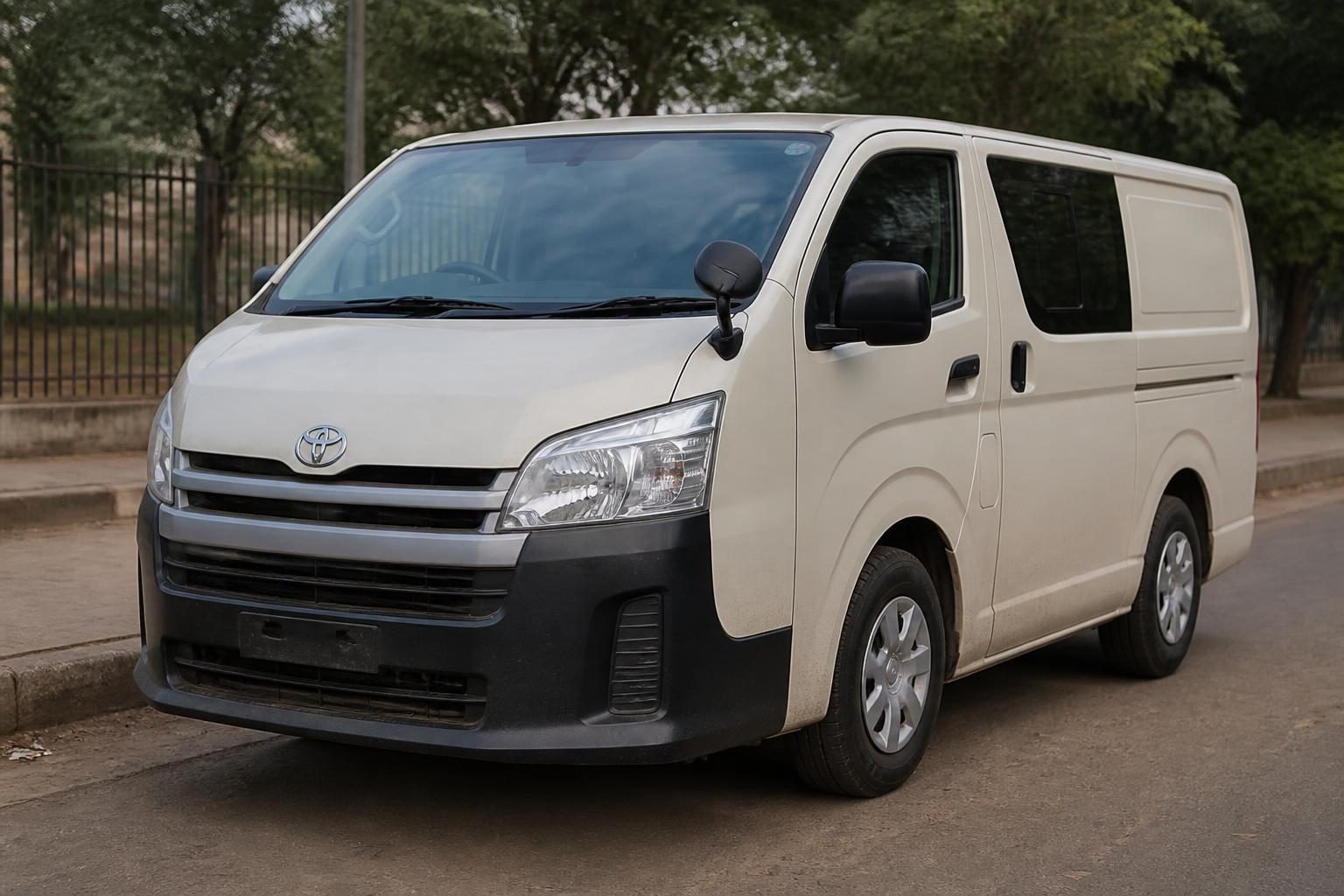 2021 Toyota Hiace
The 2021 Toyota Hiace 2.8-litre diesel 4WD is a useful reference for buyers considering commercial transport or difficult routes. As of September 2026, its vehicle page records 102,000 km, auction grade 4, an automatic transmission, 4WD, a van body and three seats.
Its 1GD-FTV engine uses turbocharging and common-rail fuel injection. Toyota also describes diesel particulate reduction and urea-SCR emissions systems on the current engine. These features support performance and emissions control, but they make suitable fuel and competent diagnosis more important.
Toyota’s 2026.01 owner’s manual specifies a 70-litre tank and ultra-low-sulphur diesel at S10 ppm or below for the current diesel model (Toyota, “Hiace Van 2026.01 owner’s manual: maintenance data”, 2026). Treat that fuel requirement as a maintenance check, not proof that every local fuel source is suitable.
Diesel suits:
- Commercial passenger transport.
- Cargo and construction work.
- Frequent inter-town travel.
- Higher annual mileage.
- Buyers with capable diesel servicing nearby.
Diesel may be a poorer fit for very short trips or infrequent use if its emissions equipment is not properly maintained, and it requires suitable fuel and competent servicing. The owner’s manual specifies S10 diesel for the cited current model, but that does not prove every local fuel source is suitable. A diesel badge alone does not make a vehicle a good purchase.
South Sudan road conditions and vehicle choice
In 2026, GOV.UK travel guidance says very few roads outside Juba are surfaced and maintained, while many roads outside the capital can become impassable during the April to November rainy season (GOV.UK, “South Sudan travel advice: Safety and security”, 2026). That makes vehicle condition more important than fuel type alone.
Rough surfaces place extra demands on tyres, suspension, steering, underbody components and cooling systems. Dust also makes air filtration and service history worth close attention. A 4WD model can help on slippery surfaces, but it does not remove the need for suitable tyres, careful driving and sound maintenance.
A full passenger load changes the engine decision. The diesel’s 300 Nm is higher than the 2.7-litre petrol’s 243 Nm and the 2.0-litre petrol’s 182 Nm, and its peak torque is available at a lower engine speed. That helps explain its potential under load, but does not prove overall load capacity, hill performance or durability.
| Engine |
Fuel |
Maximum torque |
| 2.0L 1TR-FE |
Petrol |
182 Nm |
| 2.7L 2TR-FE |
Petrol |
243 Nm |
| 2.8L 1GD-FTV |
Diesel |
300 Nm |
These are official Toyota Japan figures from the 2026 specification table. Torque helps explain load-moving ability, but it does not prove fuel economy, durability or overall suitability.
Which Toyota Hiace suits different South Sudan buyers?
In 2026, Toyota’s official range gives buyers three main engine outputs, from 182 Nm in the 2.0-litre petrol to 300 Nm in the 2.8-litre diesel. Start with the work required, then choose the engine and condition that fit it (Toyota Japan, “Hiace Van specification table”, 2026).
Juba family or staff transport
Start with a clean 2.7-litre petrol or a properly inspected diesel. Prioritise seating, air conditioning, interior condition and the vehicle’s repair history. A lower-complexity petrol van may be sensible if annual mileage is modest.
Commercial passenger operator
A 2.8-litre diesel is the stronger starting point when the van carries people every day. Check the automatic transmission, cooling system, tyres and suspension before focusing on fuel economy.
Cargo or construction business
Diesel usually makes more sense for repeated cargo work. Inspect the cargo floor, rear suspension, underbody and any structural repair marks. The van’s actual body and seating configuration must match the equipment you plan to carry.
Low-mileage owner
Petrol may be the better fit when the van covers fewer kilometres and stays lightly loaded. Lower fuel consumption is not the only ownership cost. Access to appropriate servicing and the condition of the vehicle may matter more.
What should you check before choosing a Japanese Hiace?
As of September 2026, the selected 2021 Hiace listing records 102,000 km and auction grade 4, while its inspection report records one minor lower door-edge imperfection. That shows why the auction sheet and inspection report matter more than the fuel badge alone (“2021 Toyota Hiace in South Sudan”, vehicle listing, 2026).
For every shortlisted Hiace, check:
- Auction grade and repair history.
- Structural repair or accident marks.
- Odometer consistency with interior wear.
- Engine oil leaks and starting behaviour.
- Cooling-system condition.
- Automatic transmission operation.
- Underbody impact or corrosion.
- Suspension and tyre condition.
- Warning lights, smoke and unusual noise.
- Diesel turbo, particulate and SCR equipment where fitted.
- Seating, body configuration and drivetrain.
The reports improve your decision, but they do not remove every risk. Ask questions about anything unclear before requesting a proforma invoice. You can also review how the Japan import process works and the Toyota Hiace specifications.
A vehicle with a small cosmetic mark and strong mechanical evidence may deserve more attention than a cleaner-looking van with unclear history.
Which engine should you choose?
In 2026, Toyota’s 2.8-litre diesel produces 300 Nm, compared with 243 Nm for the 2.7-litre petrol. That difference makes diesel worth considering for regular heavy loads, while petrol may suit lighter town-based work. These are conditional buying judgements, not South Sudan-specific findings from Toyota (Toyota Japan, “Hiace Van official feature page”, 2026).
Choose petrol if most journeys are around town, loads are moderate, annual mileage is lower and you find a well-inspected example. Choose diesel if the van carries people or cargo frequently, travels between towns and has access to suitable maintenance.
Skip either vehicle if the auction sheet shows serious structural damage, the mileage conflicts with the condition, the drivetrain history is unclear or the configuration does not suit your work.
How can you compare Japanese Hiace vehicles with proper records?
In 2026, the South Sudan import FAQ states that vessels depart weekly via Mediterranean Shipping Company and that the vessel journey from Japan to Mombasa takes about 24 to 36 days. Road transport into South Sudan follows afterward (“South Sudan FAQs”, importer guidance, 2026).
The useful comparison is not only petrol against diesel. Review the exact engine, drivetrain, seating layout, odometer, auction grade and inspection notes. Check the vehicle page photographs closely, then request clarification on any mechanical or structural note.
The listed vehicle and shipping amount is not the final on-road total. Duty, VAT, customs clearance, registration, licensing and possible arrival costs remain separate. Under the South Sudan Taxation Act, the sales-tax base for imported goods includes customs value plus excise duty and customs duty; confirm the current rate and vehicle classification with South Sudan customs or the NRA (South Sudan Taxation Act, 2021). Customs treatment may also vary by vehicle and destination. The official South Sudan Trade Information Hub identifies importer registration, import licensing, conformity documentation and customs-clearance steps, which should be checked before shipping.
For a documented Japan-to-South Sudan purchase, Carbarn South Sudan directly owns and inspects its listed vehicles, provides the Japanese auction sheet and in-house inspection report before payment, and includes EAA pre-shipment inspection in its process. It arranges weekly MSC RoRo shipping to Mombasa; the vehicle then continues by road into South Sudan, but confirm the exact scope of responsibility and charges for that inland leg. It also provides a proforma invoice plus dashboard access for invoices, the bill of lading, inspection reports and live vessel tracking. Compare the Toyota Hiace vehicles, review the reports, and request the next buying steps.