Both the Toyota Hilux and Land Cruiser 70 have a serious workhorse reputation. They are not built around the same compromise, though. A buyer in Juba may need one vehicle for traffic, passengers, cargo and occasional rough roads. A field operator may spend days beyond paved routes. This comparison covers work around Juba, Yei and Nimule, plus the inspection points that matter before importing.
Quick Answer
- Choose the Hilux for town driving, family use, business errands and occasional rough roads.
- Choose the Land Cruiser 70 for remote routes, difficult tracks and repeated heavy-duty work.
- In the 2023 Japanese GUN125 Hilux and LC70 references, the Hilux produces 400Nm and the LC70 produces 500Nm (Toyota Japan, Hilux specifications, 2023; Toyota Japan, Land Cruiser 70 specifications, 2023).
- A well-inspected Hilux can be a better purchase than a neglected Land Cruiser 70.
What are the main Hilux and Land Cruiser 70 differences?
The Hilux is a versatile pickup, while the Land Cruiser 70 is a heavier-duty 4x4. Toyota described the 70 Series in 2023 as a vehicle developed mainly for commercial use and harsh environments (Toyota Global, “Toyota Re-introduces the Land Cruiser 70 Series,” 2023). The Hilux favours mixed use, while the LC70 favours difficult routes and sustained heavy work.
| Specification |
2023 Japanese GUN125 Hilux reference |
2023 Japanese Land Cruiser 70 reference |
| Engine and torque |
2.393-litre 2GD-FTV diesel, 150PS, 400Nm |
2.754-litre 1GD-FTV diesel, 204PS, 500Nm |
| Fuel figure |
11.7km/L, Japanese WLTC |
10.1km/L, Japanese WLTC |
| Fuel-tank capacity |
80 litres |
130 litres |
| Body style |
Open-tray pickup |
Enclosed five-door wagon |
| Suspension |
Independent double-wishbone front; semi-elliptical leaf springs rear |
Axle-type coil-spring front; axle-type leaf-spring rear |
| Payload or seating |
500kg maximum payload |
Five seats |
| 4WD and differential-lock equipment |
Not specified in the cited reference |
Part-time 4WD; front and rear differential locks |
| Best-fit buyer |
Mixed town, family, business and cargo use |
Remote routes and repeated heavy-duty work |
The Hilux gives you an open tray for tools, farm supplies, building materials or business equipment. Its Japanese GUN125 reference uses independent double-wishbone front suspension and semi-elliptical leaf springs at the rear. That layout usually makes it easier to live with on graded roads and during regular town driving.
The Land Cruiser 70 reference model uses an enclosed five-door wagon body. It has axle-type coil-spring front suspension and axle-type leaf-spring rear suspension. That design places more emphasis on durability, traction and wheel movement when the road becomes deeply rutted or uneven.
“Stronger” does not always mean “better”. A pickup tray may matter more to a contractor than extra off-road hardware, while enclosed seating may matter more to a field team. The Toyota specifications and model details are useful when checking differences between exact variants.
The key distinction is not simply Hilux versus Land Cruiser. It is daily versatility versus specialist capability. Toyota’s 2023 reference sheets show different suspension layouts and body formats, so the right vehicle depends on how often you face difficult roads, not how impressive the badge sounds.
Is the 2023 GUN125 Toyota Hilux a good fit for South Sudan?
The Toyota Hilux models are probably the better all-round fit for buyers who mix town driving with cargo work and occasional rural travel. The 2023 Japanese GUN125 reference uses a 2.393-litre 2GD-FTV diesel producing 150PS and 400Nm at 1,600–2,000rpm (Toyota Japan, Hilux specifications, 2023).
The reference Hilux has an 80-litre fuel tank, a stated 500kg maximum payload and a 6.4-metre minimum turning radius. Its official fuel figure is 11.7km/L under Japan’s WLTC test cycle. WLTC is Japan’s laboratory fuel-economy test cycle, so actual use will depend on load, tyres, roads and driving style.
The open tray suits farmers, small businesses, contractors and families carrying equipment. It also gives you more flexibility than an enclosed wagon when dirty or bulky loads are part of the job. Around Juba, the Hilux may suit daily errands and mixed-use work, but exact dimensions and turning space vary by model.
The trade-off appears on more serious routes. Independent front suspension may offer a more settled ride in some conditions, but a specification sheet alone cannot establish a direct ride or axle-articulation comparison with the LC70. Before choosing one, inspect the tray, chassis, suspension and underbody for overloading, accident repairs or hard commercial use.
The 2023 Japanese GUN125 reference combines 400Nm, an 80-litre tank and 500kg payload with an 11.7km/L WLTC figure. That combination makes the Hilux a practical mixed-use tool, but exact engine codes and specifications must be confirmed before payment.
When does the Land Cruiser 70 make more sense?
The Land Cruiser 70 reference model makes more sense when difficult roads, remote work and sustained heavy use are central to the job. Toyota’s 2023 Japanese-market reference uses a 2.754-litre 1GD-FTV diesel producing 204PS and 500Nm at 1,600–2,800rpm (Toyota Japan, Land Cruiser 70 specifications, 2023; Toyota Global, “Toyota Re-introduces the Land Cruiser 70 Series,” 2023).
The reference 76 Series has part-time 4WD, a six-speed automatic transmission, a 130-litre fuel tank and seating for five. Part-time 4WD means the driver selects four-wheel drive when conditions require it. The listed front and rear differential locks can help maintain traction when one wheel loses grip. Toyota’s official figure is 10.1km/L under the Japanese WLTC cycle.
That specification may suit NGO field teams, agricultural operators, contractors and buyers travelling beyond regular road support. The large tank helps with longer legs between refuelling stops, but it does not make the LC70 economical. Its enclosed body keeps passengers and loose equipment enclosed, unlike an open tray.
The drawbacks are real. The cabin is more upright, and the ride may feel firmer depending on condition, tyres and load. The LC70 is taller, but the 2023 reference is shorter than the Hilux and has a slightly smaller turning radius. Tyres, suspension components and drivetrain repairs may also place more pressure on the budget. Service history and chassis condition matter more than the Land Cruiser name.
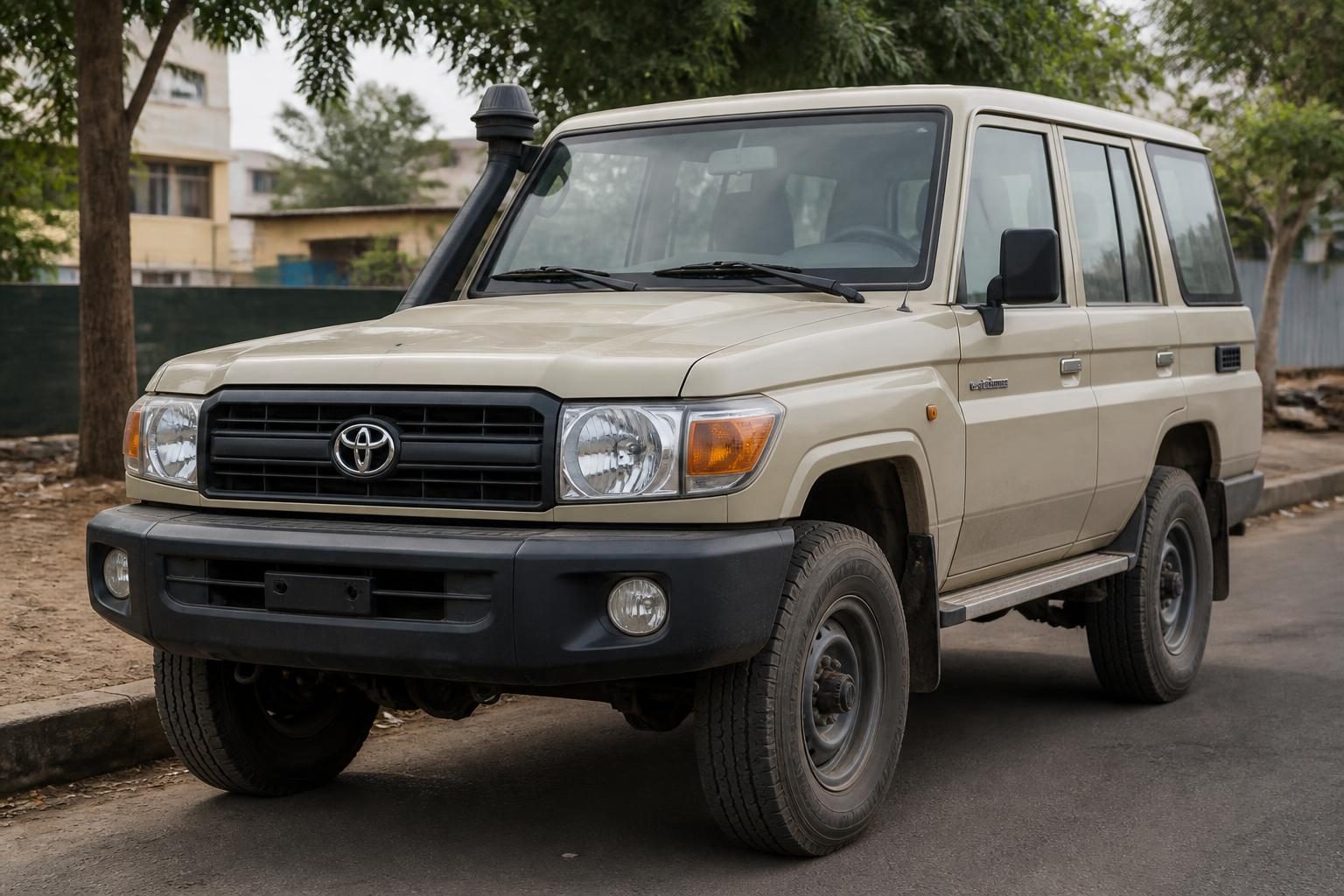 TOYOTA Land Cruiser 70
The LC70 reference model has 500Nm, a 130-litre tank, part-time 4WD and differential locks, according to Toyota’s 2023 Japanese specifications. Those features support specialist remote work, but they cannot compensate for a damaged chassis, worn suspension or poor maintenance.
Which vehicle handles South Sudan roads and ownership better?
The Land Cruiser 70 has the stronger case for consistently difficult terrain, while the Hilux is usually the better compromise for mixed use. Toyota’s 2023 Japanese GUN125 Hilux and LC70 reference figures show 11.7km/L WLTC for the Hilux and 10.1km/L WLTC for the LC70 (Toyota Japan, Hilux specifications, 2023; Toyota Japan, Land Cruiser 70 specifications, 2023). Road type, condition and parts access should decide the final choice.
How should you match the vehicle to the road?
South Sudan’s rough roads do not all stress a vehicle in the same way. Corrugations test suspension and tyre condition. Deep mud needs suitable tyres and usable four-wheel-drive equipment. Sand rewards careful pressure management and momentum, while standing water raises clearance and recovery concerns.
Seasonal conditions can change the same route between a manageable journey and a slow recovery exercise. A clean Hilux with suitable tyres may be better value than a neglected LC70. The 2023 Hilux reference has a 6.4-metre minimum turning radius, while the 2023 LC70 reference is shorter and has a 6.3-metre radius.
What should you check before comparing running costs?
The LC70’s 130-litre tank supports range, not lower fuel use. Compare tyre size, filters, suspension parts, transmission servicing and body repairs before deciding. Parts should be confirmed by engine code and drivetrain, because Toyota branding alone does not prove that every component is available locally.
Judge the exact vehicle, not the model’s reputation. Review the auction sheet, odometer records, underbody photographs, chassis, suspension, drivetrain and signs of flood or accident damage before paying.
Which Toyota should you choose for your work?
Choose the Hilux for versatility and the Land Cruiser 70 for repeated remote work. In Toyota’s 2023 Japanese GUN125 Hilux and LC70 reference data, the LC70 carries 100Nm more torque than the Hilux, while the Hilux records the stronger official WLTC economy figure (Toyota Japan, Hilux specifications, 2023; Toyota Japan, Land Cruiser 70 specifications, 2023). Neither number decides the purchase alone.
Choose the Hilux if you drive regularly around Juba, need an open cargo tray, carry tools or farm equipment, and mix paved roads with rough routes. It is probably the easier daily vehicle for a small business, family or contractor.
Choose the Land Cruiser 70 if you travel repeatedly on difficult tracks, carry field equipment far from support, or value traction and heavy-duty design above ride comfort. It is harder to justify for mainly urban driving.
A people-mover is a separate buying decision. The confirmed 2006 Toyota vehicle page shows a petrol, automatic 4WD Regius Ace Commuter with 10 seats, 68,000km and auction grade 3.5. Confirm the model code from the auction sheet or chassis documents before relying on it.
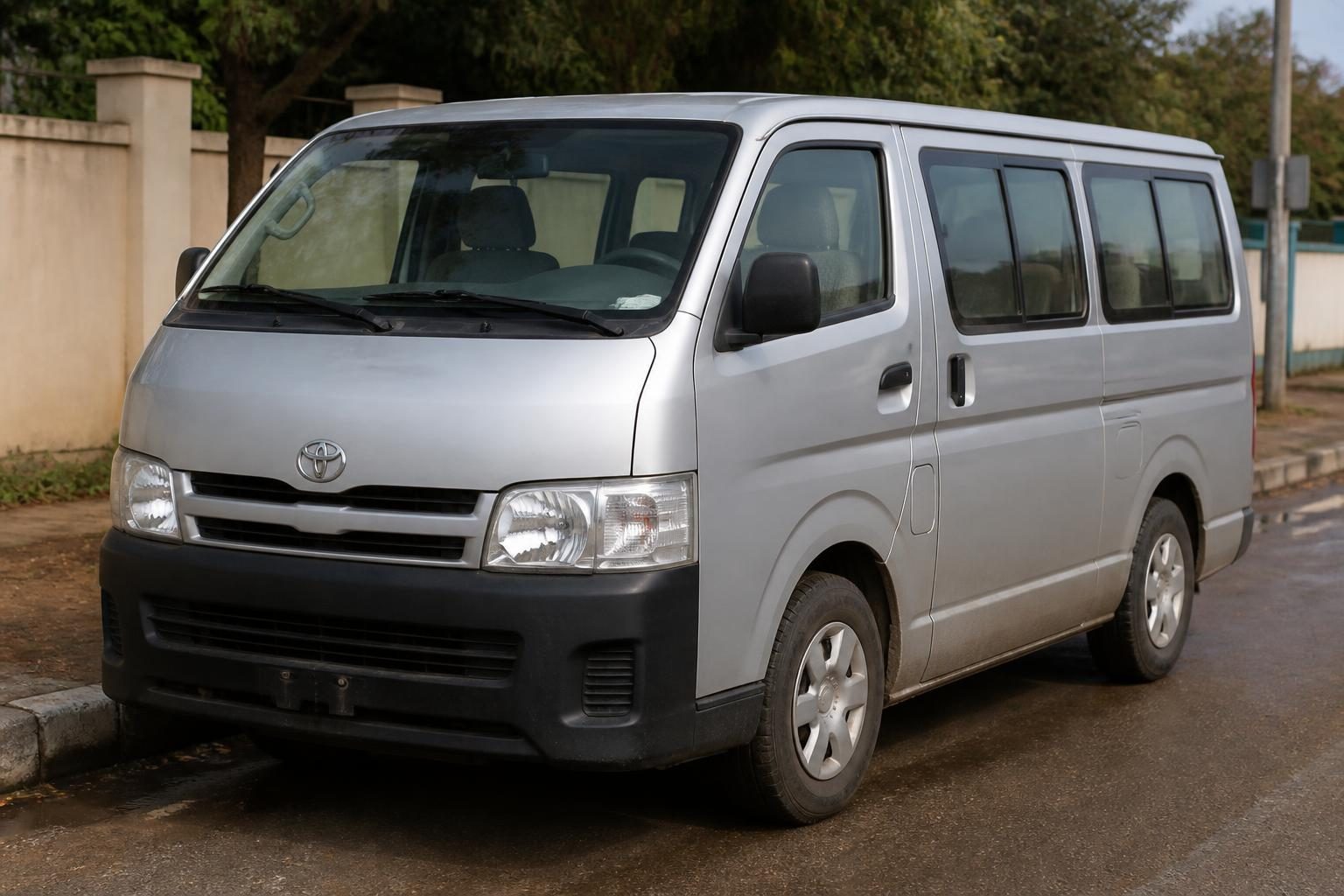 2006 TOYOTA Hiace
This format may suit passenger operators, organisations and field groups that prioritise seating over a pickup tray. Its petrol engine creates a different running-cost decision, while its 2006 model year and bus body separate it from the two diesel workhorses.
How can you compare and import either vehicle safely?
A Japan-sourced vehicle should be judged through its documents, inspection evidence and full arrival-cost picture. Check the exact engine, suspension, drivetrain and condition before payment. The vehicle price is not the final on-road cost.
Check the auction grade, auction sheet, odometer, chassis, underbody, tyres, suspension and evidence of flood or accident damage. Duty varies by vehicle and destination, including Juba, Yei and Nimule. VAT is 20% of the dutiable value according to the South Sudan import rules, but confirm the current rate and tax basis with South Sudan Customs. Clearance, registration, licensing and arrival costs remain separate.
The Toyota vehicles for South Sudan page can be used for broader model browsing. Exact variant, engine-code and chassis information should still be checked against the vehicle documents.
With Carbarn’s Japan-to-South Sudan importing service, vehicles are sourced in Japan rather than collected from a Juba showroom. The service provides the Japanese auction sheet and an in-house inspection report before payment. Mandatory JEVIC pre-shipment inspection is included. On arrival, EAA may perform a roadworthiness inspection during customs clearance, depending on the region.
Shipping uses RoRo from Japan to Mombasa, followed by road transport into South Sudan. Weekly MSC departures are available, with about 24 to 36 days from Japan to Mombasa. The listed vehicle and shipping price excludes duty, VAT, customs clearance, registration, licensing and other arrival costs.